A-Frame Outdoor LED Sign: 6 Specs That Decide If It Works
A sign you roll out of the shop at eight in the morning and roll back in at ten at night. No electrician, no fixed-structure permit, no installation crew — and no printed A-board that fades, blows over and says the same thing for a month.
What an A-frame outdoor LED sign is — and what it replaces
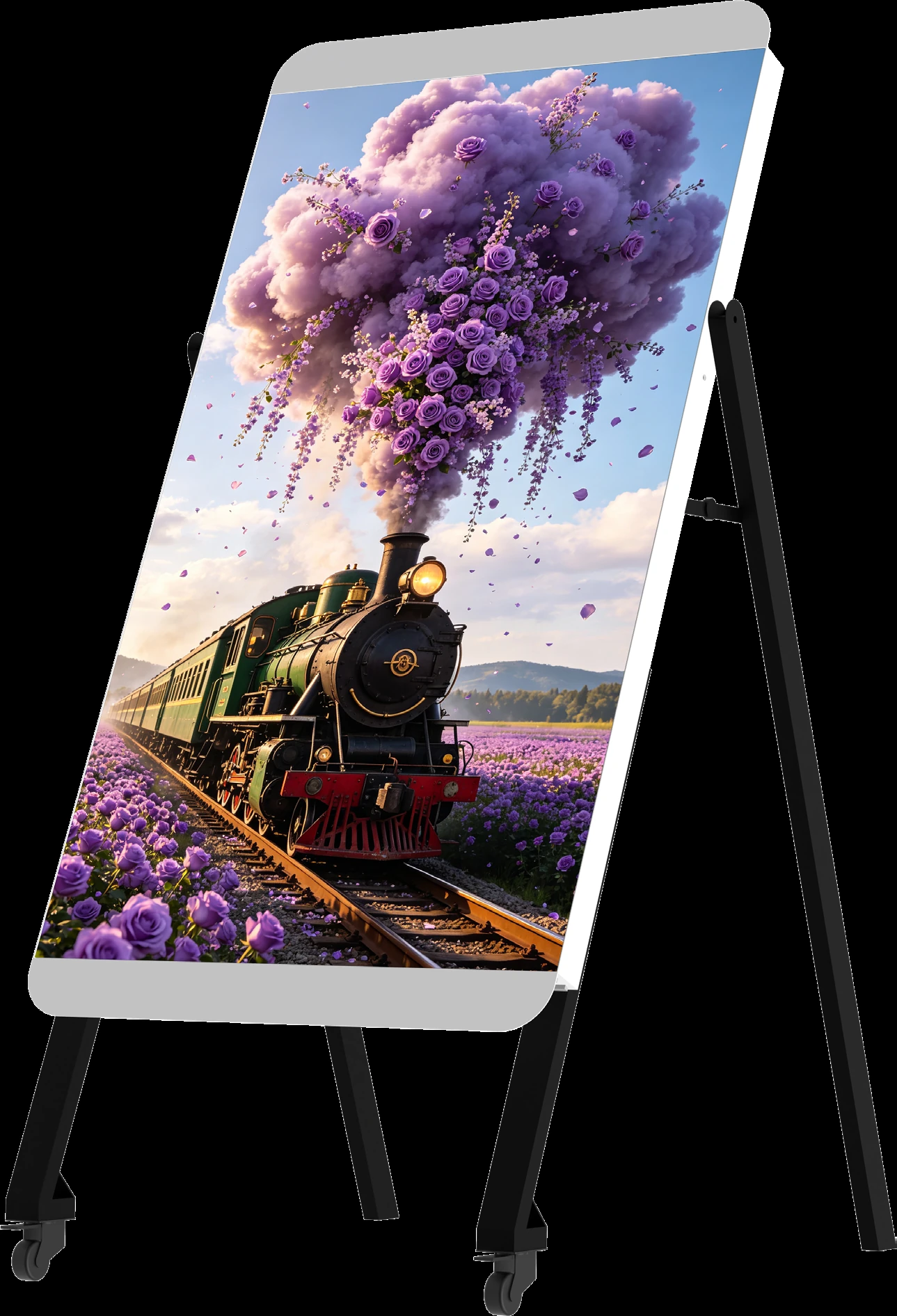
An A-frame outdoor LED sign is a battery-powered LED panel mounted in a folding A-frame chassis on casters. Everything a fixed LED screen needs — mains power, a structure, a permit, a crane — is replaced by a battery and two wheels. Roll it to the kerb, switch it on, change the poster from your phone.
It sits between three things people usually buy instead:
- A printed A-board — cheap, but one message for weeks, no night visibility, and it takes the wind badly.
- A fixed LED screen or billboard — bright and permanent, but it needs mains power, a mounting structure and, in most cities, permission for a permanent structure on the pavement.
- An indoor LED poster — excellent inside a mall, but built without a weather rating and typically 500–700 cd/m², which disappears in daylight.
The full model is described on our outdoor LED poster page; the rest of this article is the six numbers that decide whether a mobile LED sign survives where you want to use it.
Spec 1 — Brightness: 4500 cd/m² is the daylight number
Brightness (cd/m², often written as nits) is the first thing that separates an outdoor sign from an indoor one. A shopping-mall LED poster is comfortable at 600–900 cd/m² because the ambient light is low. Outdoors at noon you are competing with tens of thousands of lux, so the panel has to be several times brighter before the content stops looking washed out.
This unit is specified at 4500 cd/m² — roughly twice the 2500 cd/m² that is common in low-cost mobile signage. The practical result is that the poster stays readable in direct sunlight instead of only in shade or after sunset.
Spec 2 — IP rating: insist on full-machine IP65, not “module IP65”
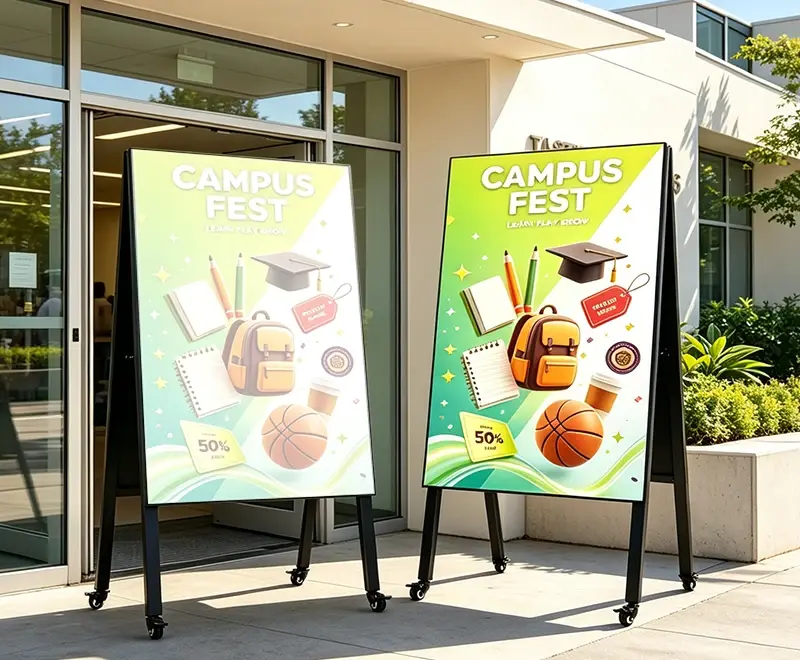
IP65 means dust-tight and protected against low-pressure water jets. The trick in this category is that many suppliers quote the rating of the module and then ship a rain cover with it — which means someone has to put the cover on every time it rains, and the sign is useless in a sudden shower.
Here the whole machine is IP65: the panel, the seams, the controller compartment and the battery bay. That is the difference between a sign that stays outside all day and one that comes indoors whenever the sky looks grey.

Spec 3 — GOB protection: why lamp beads die outdoors
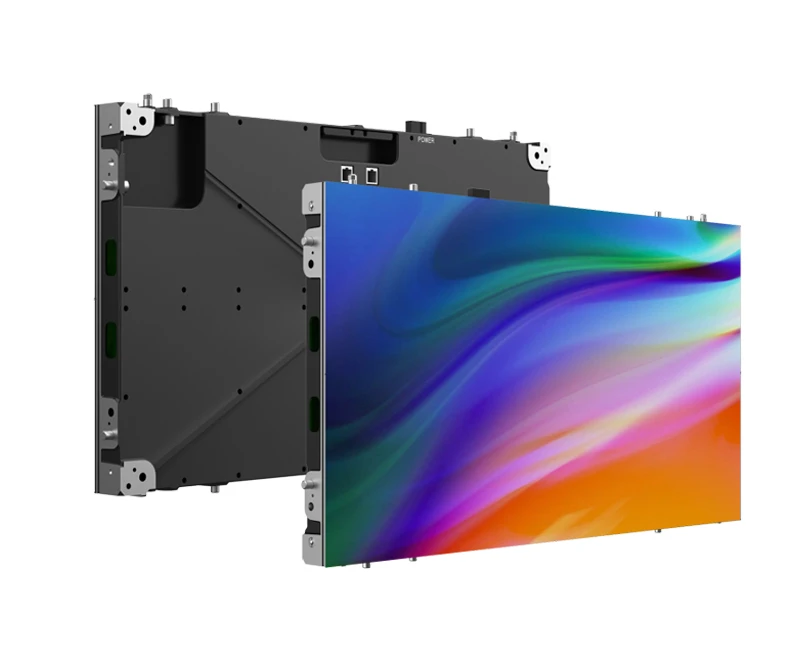
A 2.5 mm pitch screen carries thousands of tiny lamp beads per panel. Exposed beads are the number-one outdoor failure point: a trolley knocks the sign, humidity settles on the beads, and a few pixels die. Multiply that over a year and the poster starts looking damaged.
GOB (glue-on-board) pours a protective resin layer over the beads. It buys three things: impact resistance, moisture resistance and protection from oxidation — which is why coated panels report well over 90% fewer dead-pixel failures than bare-bead panels. If two suppliers quote the same brightness and pitch, this is the specification that decides which one still looks new next summer.
Spec 4 — Battery: 50 Ah / 1260 Wh is what “8–10 hours” looks like
Battery claims are where mobile signage gets vague. Ask for the numbers, not the promise. On this model the sheet reads 50 Ah / 1260 Wh at 25.2 V, rated for 8–10 working hours per charge.
Two things are worth knowing before you compare:
- The quoted 200 W average consumption depends on the content — a bright, full-motion video pulls far more than a static poster with a mostly dark background. Real poster content is what lets the same battery reach the 8–10 hour figure.
- Plan the charging rhythm, not just the runtime: a full working day outdoors, back on charge overnight, is the normal duty cycle.
Spec 5 — Pixel pitch 2.5 mm / 192 × 384: what the resolution really means
Pixel pitch is the distance between two LEDs. Smaller pitch means a sharper image at close range and more cost per square metre. This panel is 2.5 mm on a 320 × 160 mm module, 192 × 384 pixels per screen.
Translated into use: it is built for close-range reading — people a few metres away, exactly the footfall you get on a shop front, a market pitch or a show stand. It is not a highway billboard, and it does not need to be: a 2.5 mm panel this size is sharp for text, menus, promotions and short video loops. If your viewing distance is 20 metres or more, a different class of video wall is the right tool, and we say so rather than sell you the wrong screen.
Spec 6 — Weight and setup: 30 kg on silent casters
The specification sheet gives 30 kg net (33 kg gross) for the complete unit, with the panel itself only 1208.1 × 526.0 × 69.7 mm. That matters more than it sounds: it means one person can move it, and the A-frame folds flat for transport in a car boot or a small van.
Silent casters are not a detail either. A shop that wheels a screaming trolley past customers every morning ends up leaving the sign in the back room. And because the panel is battery-powered, there is no cable to tape across the pavement.

Full specification
| Specification | Outdoor mobile LED sign |
|---|---|
| Display | Outdoor LED sign, single-sided A-frame |
| Module size | 320 × 160 mm |
| Pixel pitch | 2.5 mm |
| Resolution | 192 × 384 |
| Brightness | 4500 cd/m² |
| Average power consumption | 200 W (depends on the content) |
| Lifespan | ≥ 100,000 hours |
| Refresh rate | ≥ 3840 Hz |
| IP rating | IP65 (whole machine) |
| Controller | HD-C16L, 1.5 GHz quad-core CPU, Mali-G31 GPU, 4 GB storage, Linux 4.4 |
| Content input | Wi-Fi and USB; wireless upload from the mobile app; TRS 3.5 mm audio |
| Video / image formats | AVI, MPG, VOB, WMV, MP4, RM/RMVB · BMP, GIF, JPG, JPEG, PNG, PBM, PGM, PPM |
| Battery | 50 Ah / 1260 Wh · 25.2 V input · 8–10 working hours |
| Colour | Black, white (customisable) |
| Panel size (H × W × D) | 1208.1 × 526.0 × 69.7 mm |
| Packaging | 1300 × 630 × 180 mm |
| Weight | 30 kg net / 33 kg gross |
| Operating temperature | −40 °C to +80 °C (sheet rating) |
| Humidity | 0–90% operating, 0–98% storage |
| Warranty | Screen 1 year · battery 1 year · technical support 10 years |
Where this sign earns its keep
- Shop fronts and cafés — replace the printed A-board, change the promotion at lunchtime instead of monthly.
- Markets and street pitches — battery power means nobody negotiates an extension lead with the neighbouring stall.
- Car forecourts and property viewings — roll it to whichever vehicle or unit is in focus that day.
- Trade shows and events — folds flat, goes in the van, runs on its own battery all day.
- Seasonal pop-ups — a month of visibility without a permanent installation.
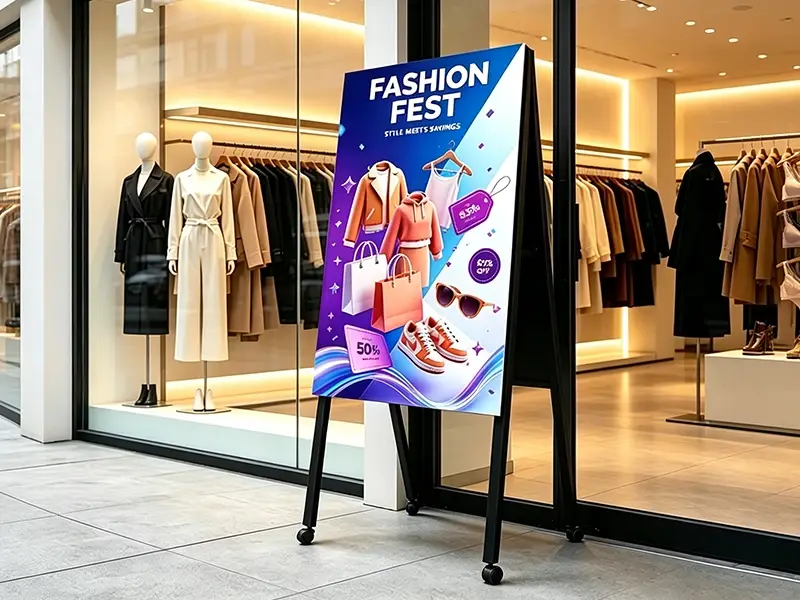
For indoor applications where weather protection is not needed, the lighter foldable LED poster and the indoor LED poster range are usually the better buy.
Battery LED sign vs printed A-board
| Over a year of use | Battery A-frame LED sign | Printed A-board |
|---|---|---|
| Message changes | From the phone app, in seconds, as often as you like | Reprint and rebuild the board |
| Night and rain | 4500 cd/m², IP65 whole machine | Unreadable in the dark, and paper does not like rain |
| Wind | 30 kg on casters | Blows over, needs a water base |
| Message capacity | Text, images, video, promotions | One fixed design |
| Setup | One person, under a minute | Signwriter, print shop, lead time |
| Running cost | Recharge overnight | Reprint every campaign |
We deliberately do not print prices in this guide — configuration, quantity and delivery market change the number materially, and a stale price is worse than none. Ask for a quotation and you get it the same working day. Technical sheets for the whole display range are on the specification page.
Frequently asked questions
Can an outdoor LED sign stay in the rain?
Yes — this one is rated IP65 for the complete machine, so no rain cover is required. Water jets from low pressure and dust ingress are both covered by the rating.
How long does the battery last per charge?
The sheet gives 8–10 working hours from a 50 Ah / 1260 Wh battery, with average consumption depending on the content. Static posters run longer than bright full-motion video. Normal practice is a full day outside and charging overnight.
Do I need a computer to change the content?
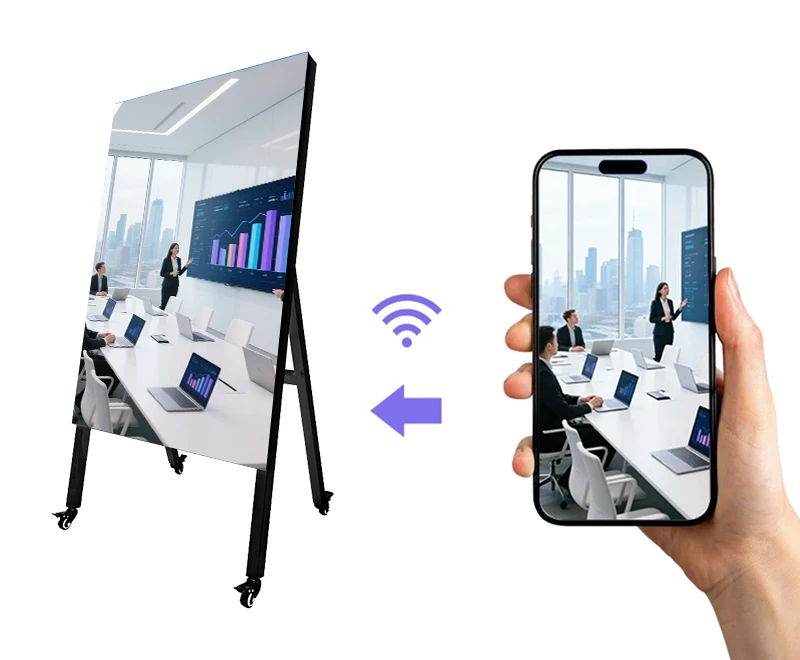
No. Content is uploaded wirelessly from the mobile app, and a USB port is available as an alternative. New promotions can be published from the pavement outside the shop.
Can one person move and set it up?
Yes. The complete unit is 30 kg net on silent casters, with a folding A-frame that fits into a car boot or small van.
Is 2.5 mm pitch right for my location?
It is ideal for close-range viewing (a few metres) — shop fronts, market pitches, reception areas and exhibition stands. If people will read it from 20 metres or more, a larger-pitch LED video wall suits the job better.
Related Product
Related Articles
WhatsApp: +86 198 9911 4307
Email: jeff@riotouch.com · Riotouch Technology