Riotouch Applications: The Sixteen Classroom AI Apps, Measured Against the Evidence
Riotouch Cloud · Deployment series, part 4 of 4. Series: 1 On-Premise Compute · 2 Cloud Compute · 3 Cloud Services · 4 Applications.
Quick answer
The application layer is where a school’s money is actually judged: sixteen AI applications, from generation and 3D modelling to writing correction, speaking practice, lab simulation, coding tutoring, sports analytics, reading comprehension, translation, learning analytics, video editing, a Socratic study companion and automated scheduling. Three of them have direct, peer-reviewed or vendor-published outcome evidence — AI tutoring, reading fluency and early-literacy practice — and the rest inherit their feasibility from the same mechanisms. This article separates the two: what is proven to improve learning, and what is proven technically feasible but still needs your own measurement.
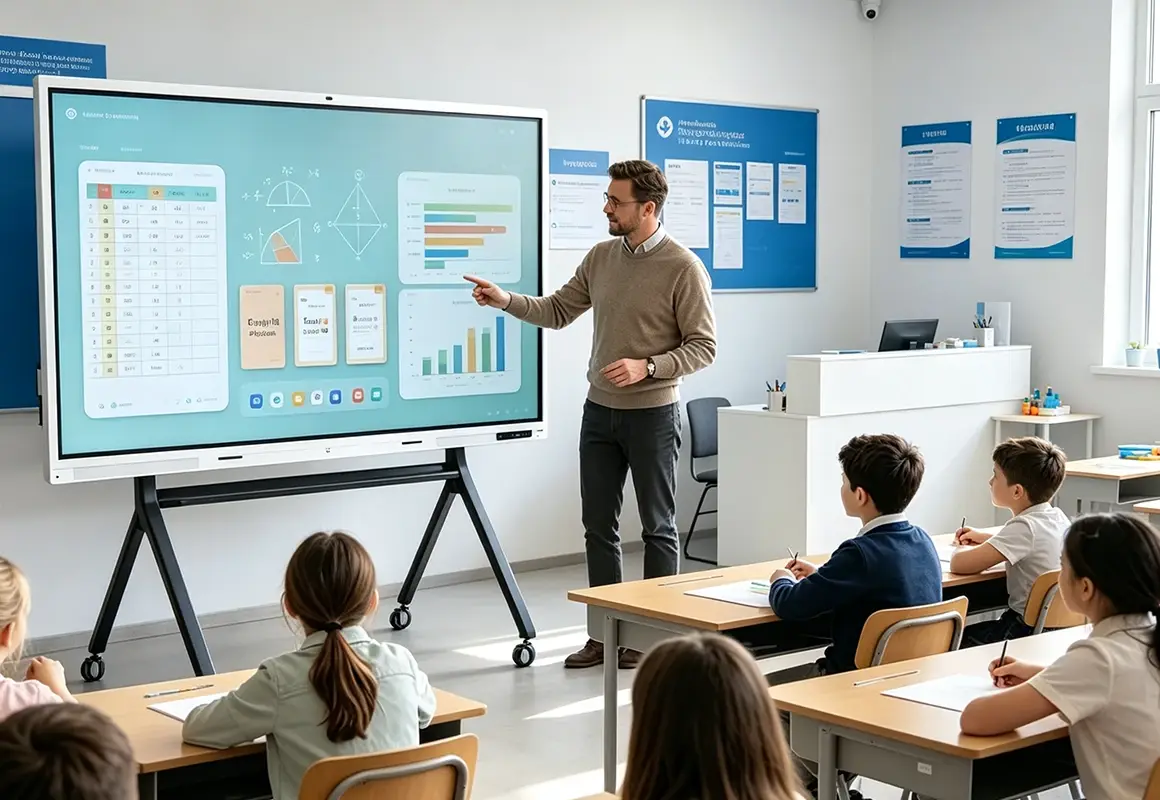
1. The sixteen applications, as deployed
| # | Application | What it does |
|---|---|---|
| 1 | AI Generation | Text-to-image, text-to-video and presentation generation |
| 2 | AI Problem Solving | Step-by-step reasoning across maths, physics, chemistry and coding |
| 3 | AI 3D Modelling | Molecules, geography and history scenes, 3D model generation |
| 4 | AI Interactive Courses | AI-generated interactive courseware; quiz and role-play modes |
| 5 | AI Writing Assistant | Essay and report correction, grammar and structure feedback |
| 6 | AI Speaking Coach | Pronunciation, fluency and dialogue scoring |
| 7 | AI Lab Simulation | Simulated physics, chemistry and biology experiments |
| 8 | AI Coding Tutor | Code generation, debugging and guided programming practice |
| 9 | AI Music / Art | Creation and appreciation exercises |
| 10 | AI Sports Analytics | Motion recognition and health or movement tracking |
| 11 | AI Reading | Annotation, comprehension questions and summarisation |
| 12 | AI Translation | Multilingual translation and subtitles |
| 13 | AI Learning Analytics | Weak-spot tracking and personalised learning paths |
| 14 | AI Video Editing | Replay and highlight generation from class recordings |
| 15 | AI Companion / Tutor | Socratic guidance and study companionship |
| 16 | AI Scheduling | Timetable conflict detection and optimisation |
Every one of them runs behind the same gateway and model pool as parts 1–3, which means a school can choose per application whether inference happens locally (on-premise, student data never leaves) or in the cloud (redacted-only, elastic). See the Riotouch Cloud solution for the full stack.
2. What the evidence actually supports
2.1 AI tutoring — randomised, controlled, peer-reviewed
The strongest single result in this space is a 2025 randomised controlled trial published in Scientific Reports (Nature Portfolio): students using a custom AI tutor “learn significantly more in less time” than students in an in-class active-learning setting, and report higher engagement and motivation. The study has been read more than 211,000 times and cited 189 times, and its design deliberately mirrors the pedagogical practices of the human-taught lessons it is compared against [1].
What this means for application #15 (AI Companion / Tutor) and #4 (Interactive Courses): the mechanism is validated — a well-designed AI tutor can outperform in-class active learning for the tasks tested. It does not mean any AI tutor does: the study is explicit that the design was informed by research-based pedagogy, which is why Riotouch ships a prompt library and workflow and output review in the AI-Gen platform rather than a bare chat box.
2.2 Reading fluency and early literacy — vendor-published outcome studies
Microsoft’s education team published a 2024 study of Reading Progress, its reading-fluency tool integrated into Teams for Education, reporting improved reading scores in a study conducted with LearnPlatform. The deployment context was Fresno Unified School District, the third-largest district in California with roughly 71,000 students, which adopted the tool as part of a first-grade literacy initiative [2].
Google’s Read Along pilot, run in 200 villages in India with about 1,500 children (920 treatment, 600 control), reported that 64% of participants with access to the app showed an improvement in reading proficiency, with about 92% of surveyed parents noticing improvement — and Google itself flags in the same document that further research is needed before broader claims [3].
What this means for application #6 (Speaking Coach) and #11 (AI Reading): automatic speech recognition plus immediate feedback demonstrably moves reading and speaking outcomes in real deployments. Both sources are honest about scope — Microsoft’s is a district case study, Google’s is an initial pilot — so a school should treat these as “evidence of effect in comparable settings”, not as a guarantee of effect size in its own cohort.
2.3 Classroom AI governance — the responsible-development literature
Google’s LearnLM work, published as Towards Responsible Development of Generative AI for Education: An Evaluation-Driven Approach, sets out how education-specific evaluation criteria should shape a model’s behaviour before deployment [4]. UNESCO’s Recommendation on the Ethics of Artificial Intelligence provides the policy framing that ministries and school boards increasingly cite in procurement [5].
What this means for all sixteen applications: the interesting question is no longer “can the model do it?” but “which evaluation criteria, and who reviews the output?” Riotouch’s answer is structural — the AI Gateway logs every request, the AI-Gen platform keeps prompts and workflows reviewable, and output review is part of the workflow.

2.4 The rest — feasible, verifiable, measurable on site
Applications #1, #2, #3, #7, #8, #9, #10, #12, #13, #14 and #16 do not have the same level of published outcome evidence, and we will not pretend otherwise. What they do have is:
- Technical feasibility at classroom scale — the same inference stack documented by Microsoft for local model execution and by Google for on-premises and cloud AI deployment (see parts 1 and 2).
- Standards-based delivery — the services layer (part 3) exposes them through an LMS implementing LTI 1.3 and SCORM, so usage can be instrumented rather than guessed.
- Measurable instrumentation — device, behaviour and learning analytics (part 3) can report per-class, per-subject adoption and outcome deltas, which is how a school converts a pilot into a decision.
3. Advantages of the application layer — each tied to a source
| Advantage | What it means | Supporting evidence |
|---|---|---|
| Learning gains are not hypothetical | A peer-reviewed RCT found AI tutoring produced significantly more learning in less time, with higher engagement. | Scientific Reports RCT, 2025 [1] |
| Literacy and speaking practice move first | Reading-fluency and spoken-language tools with automatic feedback have published outcome evidence in real districts and pilots. | Microsoft Reading Progress study [2]; Google Read Along pilot, 64% [3] |
| Governed by design | Prompts, workflows and outputs are reviewable, and every request is logged. | Google LearnLM evaluation-driven approach [4]; UNESCO ethics recommendation [5]; Riotouch AI Gateway |
| Deployment-mode agnostic | The same sixteen apps run on-premise, in the cloud or hybrid, so privacy constraints do not subtract features. | Parts 1–3 |
| Instrumentation closes the loop | Analytics and dashboards turn adoption into measurable outcomes rather than anecdote. | Part 3 analytics service; [1][2][3] for outcome metrics worth tracking |
| No third-party dependency for core teaching flows | Translation, subtitle, meeting and recording functions sit inside the platform. | Part 3, ref. 8 |
| Teacher-time leverage | Generation, correction, exam-question generation and scheduling offload repetitive work. | [1] reports learning gains in less time; [2] highlights time savings for educators |
4. How to run a defensible pilot
- Pick two applications with external evidence (#15 tutoring, #6/#11 reading and speaking) and one productivity application (#5 writing or #16 scheduling).
- Define the outcome before deployment — a reading-fluency score, an assessment delta, or time saved per teacher per week.
- Use the platform’s own analytics to measure it, per class, for one term.
- Reveal the privacy posture to parents and staff up front: which deployment mode (parts 1–3) the school chose, and what leaves the campus.
- Scale what moved; retire what did not. That is a defensible AI programme, and it is also what the evidence base actually supports.
Interested in the hardware that runs these applications? See the RK3576 4K interactive flat panel and the Aether Orb AI Box (OPS), or read part 3 for the cloud services layer.
Conclusion
Classroom AI is not one product; it is an application layer sitting on top of a deployment model. Separate what has external evidence from what has technical evidence, instrument both per class, and the decision stops being ideological. That is the whole point of the four parts of this series: choose the compute model (part 1 or 2), deliver it through one managed services stack (part 3), and then judge the applications on outcomes you measured yourself (part 4).
References
- AI tutoring outperforms in-class active learning: an RCT introducing a novel research-based design in an authentic educational setting, Scientific Reports 15, 17458 (2025). https://www.nature.com/articles/s41598-025-97652-6
- Microsoft Education blog — New study shows improved reading scores by using Reading Progress (Fresno Unified School District; study with LearnPlatform). https://microsoft.com/en-us/education/blog/2024/08/new-study-shows-improved-reading-scores-by-using-reading-progress
- Google — Read Along: Initial Pilot Findings (~1,500 children, 920 treatment / 600 control, 64% improvement). https://services.google.com/fh/files/misc/read_along_pilot_findings.pdf
- Google Research — Towards Responsible Development of Generative AI for Education: An Evaluation-Driven Approach (LearnLM; arXiv:2407.12687). https://arxiv.org/abs/2407.12687
- UNESCO — Recommendation on the Ethics of Artificial Intelligence. https://www.unesco.org/en/artificial-intelligence/recommendation-ethics
- 1EdTech — LTI Core Specification 1.3 (interoperability for tools and content). https://standards.1edtech.org/lti/specifications/core/lti-spec1p3p1
- Microsoft Learn — Get started with Foundry Local (local model execution behind an application API). https://learn.microsoft.com/en-us/windows/ai/foundry-local/get-started
- W3C — WebRTC: Real-Time Communication in Browsers. https://www.w3.org/TR/webrtc/
All links verified live on 2026-10-09. The application list in section 1 reflects Riotouch’s published platform architecture; claims about learning outcomes are attributed to the cited studies and should be re-measured locally.
Related Product

Related Articles
Planning a Classroom AI Pilot?
Tell us your class size, subjects and privacy constraints and we will map the applications to the right deployment mode.