How to Choose a Large-Format Touch Panel: A Buyer’s Guide for 98″, 100″, 105″, 110″ and Beyond
Once you move past 86 inches — into the 98″, 100″, 105″, 110″ and larger class — the interactive flat panel market changes fundamentally. Panel supply narrows, price gaps widen dramatically, and installation logistics stop being an afterthought and become a hard constraint. This guide looks specifically at that ultra-large segment and at what actually matters when you are choosing between the few platforms that can build it.
The most important shift is this: you are no longer choosing between dozens of comparable products. You are choosing between a handful of viable platforms, each with different trade-offs in panel sourcing, system architecture and long-term support. On a display that is expected to work for five to seven years, those trade-offs matter far more than a paper specification sheet.
The 98″+ threshold: what actually changes
Most interactive flat panel brands top out at 86 inches. Beyond that line, the number of manufacturers who can reliably mass-produce panels drops sharply, and the reasons are structural rather than commercial: larger glass, different bonding processes, heavier mechanical structures and much higher logistics demands.
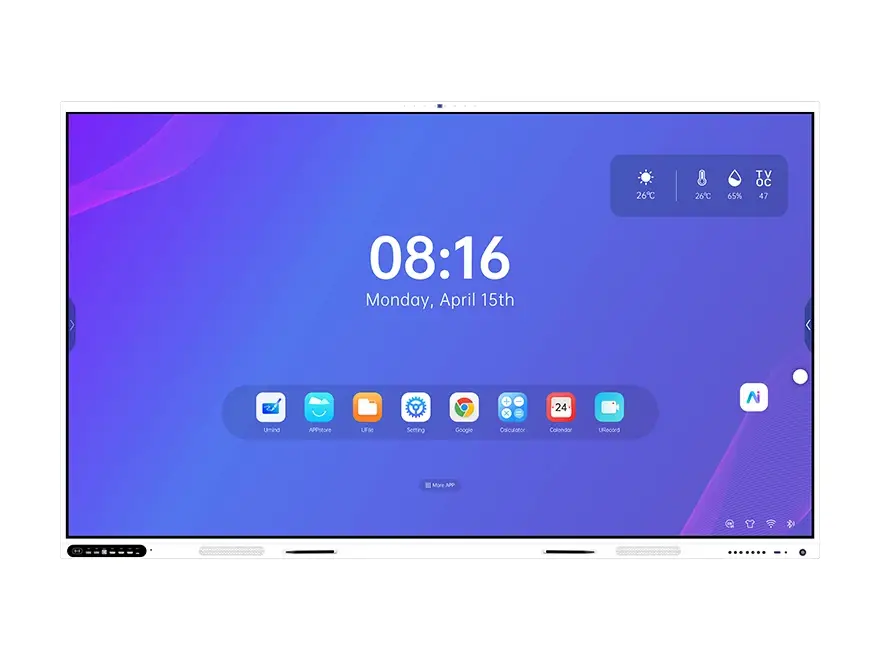
Riotouch is one of the few manufacturers that builds a single platform across 65″ to 110″, with the RK3588 flagship line covering 98″, 100″, 105″ and 110″ interactive flat panels. That matters for a practical reason: a platform built to carry a 110″ panel also carries the mainboard, firmware and spare-part supply for the whole family, so the smaller sizes in the same series inherit the reliability engineering of the largest one.
| Common assumption | What is actually true above 86″ |
|---|---|
| Any brand can build it | Beyond 86″ only a few manufacturers can reliably mass-produce the panel |
| Capacitive touch will be available | Infrared (IR) is the production standard at this size |
| The computer can be replaced later | Only if the platform has an OPS slot — otherwise the board dates the whole room |
| The quote is the total cost | The installation route, window removals and crane lifts are usually extra |
| A bigger screen is just bigger | Shipping weight and crate dimensions change what the building can accept |
Touch technology: why IR is effectively your only option
At this size, capacitive (PCAP) touch panels are not a realistic production option. Infrared (IR) is the standard, and the question becomes how well the IR system is implemented — not which technology to choose.
Riotouch’s large-format panels use 40-point IR multi-touch with palm rejection, and support finger, pen and eraser input. The practical test is not the touch-point count. It is edge precision and writing lag during real tasks, so ask for a demo that includes small handwriting, annotation near the corners, and two people writing at the same time. Bring a checklist rather than a spec sheet: how small can a character be before it is misread, does the annotation keep up with fast writing, and does the display still track correctly after an hour of use.
System architecture: can the panel survive three years?
A 110″ panel is a long-term capital investment, and the internal compute module should be replaceable rather than disposable. A display whose Android board cannot be upgraded becomes obsolete long before its panel wears out.
Riotouch addresses this with an OPS slot on the RK3588 series: a Windows module can be added and switched with the Android system on demand, so the same screen can run Android applications and full desktop software. The base Android configuration starts at 16GB RAM and 256GB storage, with options up to 32GB and 512GB. Higher memory matters at 4K resolution, where large-format panels frequently struggle with multi-application performance.
Panel quality: zero bonding and anti-glare matter more at scale
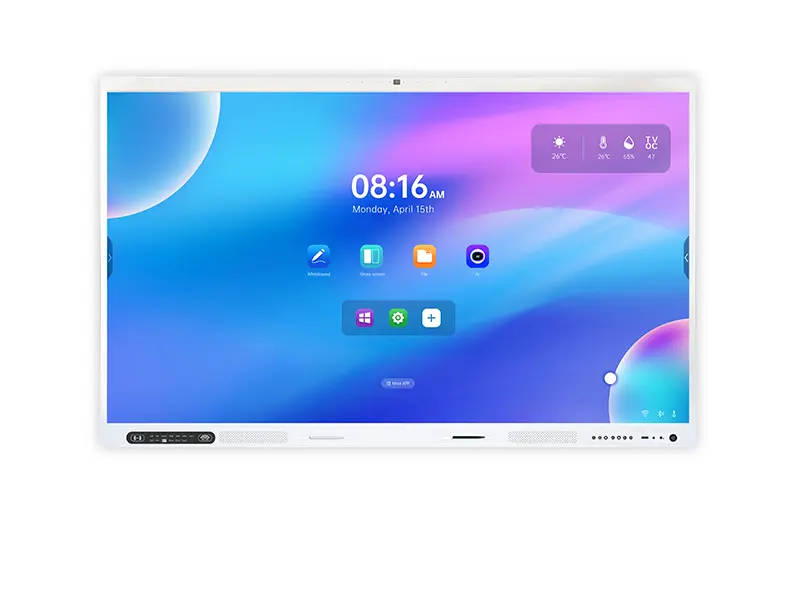
On a 110″ screen, any air gap between the glass and the LCD layer creates visible parallax and internal reflection. Riotouch uses zero-bonding optical technology to eliminate that gap, combined with 7 Mohs anti-glare tempered glass.
In a large room with windows, anti-glare is not a luxury feature — it decides whether the screen is usable during daytime sessions. Walk into the room at the time of day the panel will normally be used, with the blinds in their normal position. A panel that looks brilliant in a showroom at 9am can be unusable in a south-facing auditorium at 2pm.
Built-in AV: eliminating the cable clutter
Large rooms amplify every problem created by external cameras and microphones: cables that fail, devices that are not charged, audio that is not routed. Riotouch integrates an optional 48MP AI camera with auto-framing and an 8-microphone array with speaker tracking and 10-meter pickup.
For lecture halls and boardrooms, this removes separate AV hardware and the failure points that come with it. It also shortens the daily setup time from several minutes of cable work to pressing one button — which, over a year of daily use, is the difference between staff using the room properly and staff avoiding it.
The lineup: 98″, 100″, 105″ and 110″
These large-format panels are built on the RK3588 platform, the company’s flagship tier. The key sizes serve distinct scenarios rather than being simple steps on a ladder.
| Size | Best suited to | What to know |
|---|---|---|
| 98″ | Standard lecture halls, mid-size auditoriums | The practical starting point for large rooms; ENERGY STAR certified |
| 100″ | Buyers wanting a marginally larger canvas | Nearly identical display area to the 98″ (2.73 m² vs 2.72 m²), differentiated mainly by brightness and refresh rate |
| 105″ | Board work and writing-heavy teaching | 21:9 ultra-wide ratio — far more horizontal writing space; confirm content format (16:9 material shows side bars) |
| 110″ | Auditoriums and executive boardrooms | Flagship size: about 23% larger than the 98″ and roughly 10 kg heavier, with 120Hz refresh on the same panel platform |
Choosing by scenario and budget
- Large classroom on a limited budget — choose 98″. It is the practical starting point for large spaces: enough display area for back-row viewing, more cost-controlled than the 110″, and it runs all day. The ENERGY STAR certification on the 98″ model also means lower long-term electricity cost for all-day operation.
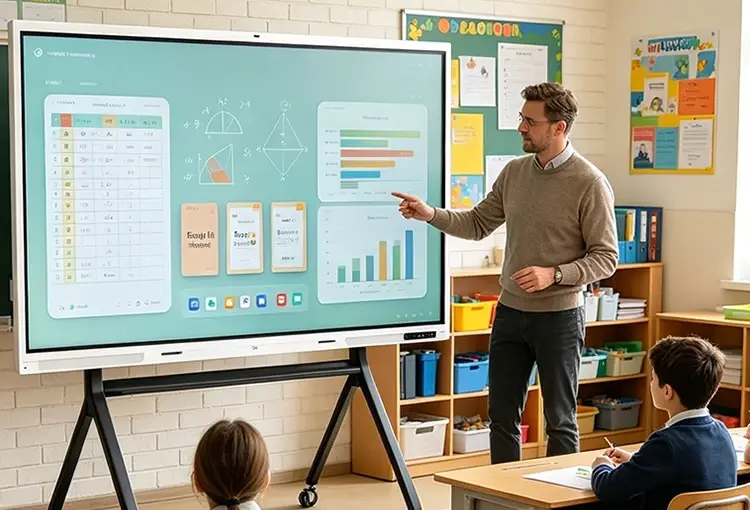
- Budget is comfortable and writing space matters — look at 105″ or 110″. The 105″ uses a 21:9 ultra-wide ratio, so its horizontal width far exceeds a 16:9 screen of the same diagonal. For teachers this is a genuine difference: formulas, multi-step derivations and side-by-side material can expand horizontally without constant erasing or page turns. The premise is that your classroom layout and your content format suit an ultra-wide screen.
- High-value rooms with frequent hybrid meetings — 110″. The integrated AI camera and microphone array remove external AV, and the OPS slot protects the investment when the compute module eventually needs upgrading.
Beyond 110″: COB Smart LED
If your requirement exceeds 110″, the answer is not a bigger LCD panel — it is Riotouch’s COB Smart LED series, available in 108″, 136″ and 163″. COB (Chip-on-Board) technology encapsulates the LED chips directly on the PCB, producing a seamless flat surface with better protection and a better touch experience than traditional splicing.
The COB Smart LED is an all-in-one design that integrates an AI camera, real-time multilingual translation, wireless collaboration for 16+ devices and intelligent O&M — positioned for corporate boardrooms, smart classrooms and government command centres. For rooms that need more than 110 inches, it is a more complete solution than assembling a video wall from modules.
Installation and logistics: the constraint nobody talks about
A 110″ panel’s shipping weight and packaging dimensions exceed what many standard elevators and doorways can accommodate. Riotouch ships these units in wooden cases, but the physical path into the room has to be measured before ordering: door width, elevator cabin dimensions, corridor turns and stairwell clearance.
In some buildings a window removal or a crane lift is required, and that cost is rarely included in the panel quote. Riotouch offers both wall-mount and mobile stand options, but for a 110″ unit the stand itself is a heavy-duty component. Confirm the full assembled footprint and the clearance requirements with your supplier before the room is prepared rather than after the crate arrives.

The practical decision framework
| Scenario | Recommendation | Why |
|---|---|---|
| Large lecture hall or auditorium, budget available | 110″ RK3588 | Integrated AI camera and 8-mic array remove external AV; the OPS slot protects the investment |
| Mid-size classroom or corporate training room | 98″ RK3588 | The practical entry to the format, with ENERGY STAR certification for all-day use |
| Large classroom needing ultra-wide writing | 105″ 21:9 | Real horizontal advantage for board work and side-by-side content — confirm your content format |
| Requirement beyond 110″ | COB Smart LED (108″/136″/163″) | Seamless surface, integrated touch and a complete all-in-one AI ecosystem |
What to verify before you buy
- Test the writing experience on the actual unit. Small handwriting, corner annotation and two-user writing reveal far more than a specification table.
- Measure the installation path. Door width, lift cabin, corridor turns and stairwell clearance — and decide in advance what happens if the crate does not fit.
- Prioritise a replaceable compute module over peak specifications. The board will be outdated before the panel is; the panel is the part you are really buying.
- Confirm your content format. Ultra-wide 21:9 is a real advantage for writing, and a real compromise for 16:9 courseware.
- Check the service model. Spare parts, remote diagnosis and local service coordination matter more on a large panel than on a 65″ one. Specifications for every current model are published in the product specification library.
If you are comparing platforms, our RK3588 LTF series overview and the 98″ ENERGY STAR certification notes cover the two ends of this size range in more detail.
FAQ
At what size does the interactive flat panel market actually change?
Above 86 inches. Most brands finish there, so from 98 inches upward the number of manufacturers that can reliably mass-produce panels falls sharply. That is why the 98″–110″ class is a platform decision rather than a product comparison.
Is capacitive touch available on 98″ and 110″ panels?
Not realistically. At this size infrared (IR) is the production standard. The meaningful questions are edge precision, writing lag and multi-user tracking — which is why a live demo with small handwriting and corner annotation is more useful than a touch-point count.
Why does the 105″ use a 21:9 ratio, and what is the catch?
21:9 gives far more horizontal writing space, which suits board work, formulas and multi-step derivations without constant erasing or scrolling. The catch is that standard 16:9 courseware shows side bars, so confirm your content format before purchasing.
Can the panel be upgraded when the computer becomes outdated?
Yes, on the RK3588 series: the OPS slot accepts a Windows module that can be switched with the Android system. Base configurations start at 16GB RAM and 256GB storage, with options up to 32GB and 512GB. That upgrade path is what keeps a five-to-seven-year panel investment current.
What should be checked before ordering a 110″ panel?
The physical path into the room: door width, elevator cabin dimensions, corridor turns, stairwell clearance and the assembled footprint with a wall mount or mobile stand. A 110″ unit ships in a wooden case and may require a window removal or crane lift, which is rarely included in the panel price.
Related Product
Interactive Flat Panel (65″ – 110″)
One platform from 65″ to 110″ — 98″, 100″, 105″ and 110″ in the RK3588 flagship line, with 40-point IR touch, zero bonding and an upgradeable OPS slot.
View Product →
COB Smart LED (108″ / 136″ / 163″)
All-in-one LED for rooms beyond 110″: seamless Chip-on-Board surface, integrated AI camera, real-time translation and wireless collaboration for 16+ devices.
View Product →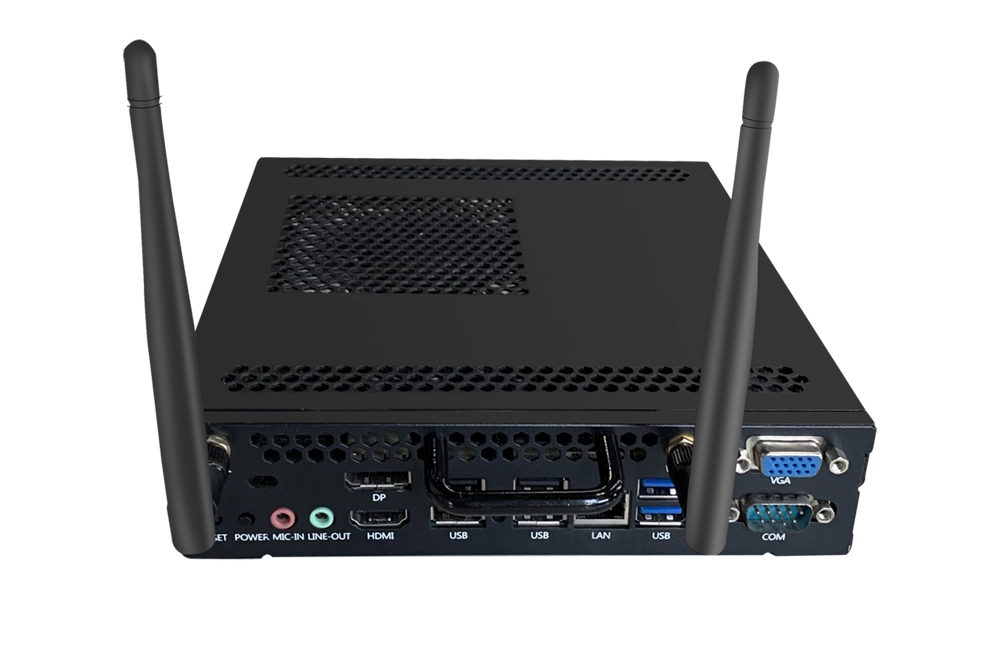
OPS Module
Slot-in Windows PC module — run desktop software, legacy teaching tools and Windows-only applications on the same large-format display.
View Product →