LED Poster Display: What to Check Before You Buy One (2026 Guide)
Short answer: an LED poster display is a freestanding vertical LED screen that replaces a printed poster. The two decisions that matter are the LED packaging (COB or SMD) and the brightness your location actually needs.
This guide is written from the questions buyers send us before an order: what COB really changes, which size fits which venue, why two posters that look identical in a showroom behave completely differently after 18 months, and what to put in an RFQ so that quotes come back comparable.
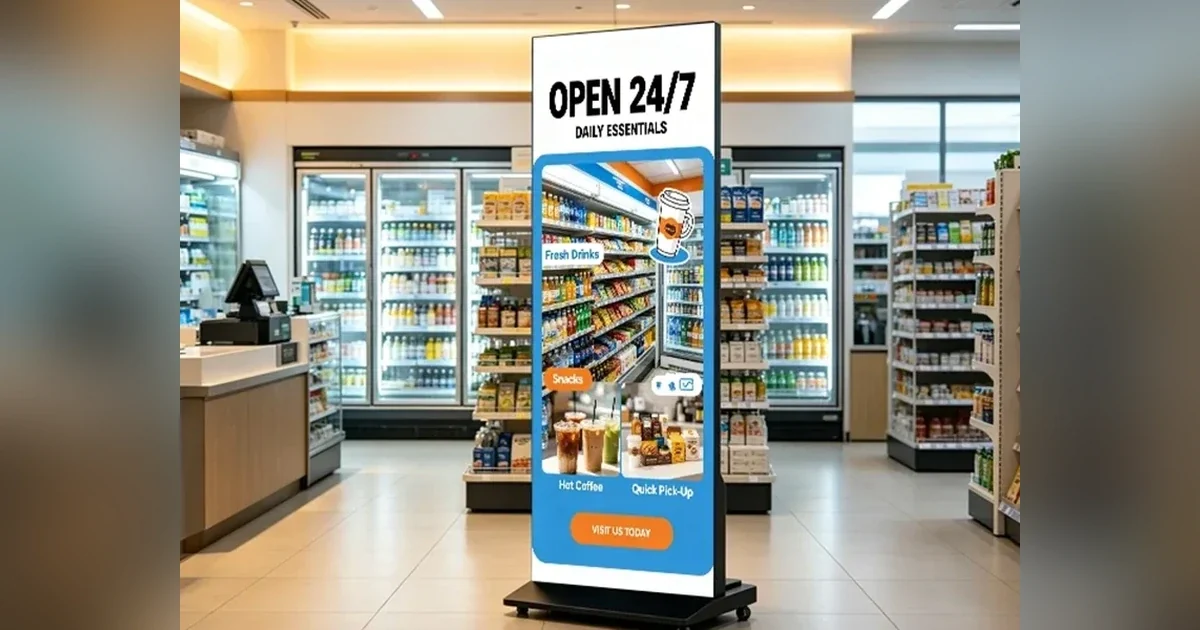
What an LED poster display actually is
A poster display is built from LED modules mounted in a slim cabinet, driven by a control board, and stood on a wheeled base. It is not an LCD screen in a frame, and that distinction decides everything else:
- No bezel, no seams within one poster. The image goes edge to edge.
- Brightness is measured in cd/m² and can be pushed far higher than LCD — which is why posters are readable in a bright mall corridor where an LCD looks washed out.
- Modules are serviceable. A failed module is replaced individually rather than scrapping the whole panel.
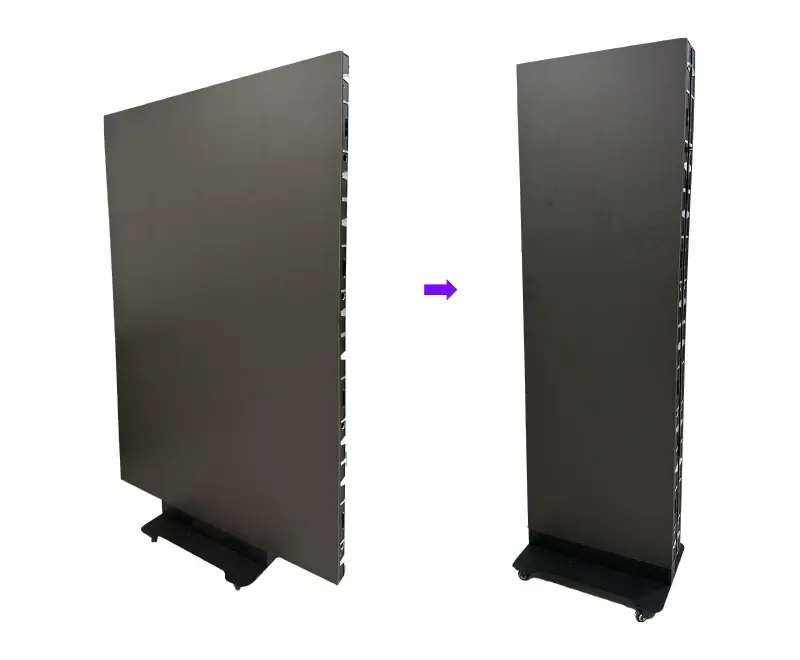
- Sizes are unconventional by LCD standards — tall and narrow rather than 16:9.
COB vs SMD: the decision that costs the most to get wrong
Both are ways of attaching LED chips to the module. SMD mounts each chip in a small plastic package with exposed pins; COB (Chip-on-Board) encapsulates the chips directly onto the board under a protective layer.
| SMD LED poster | COB LED poster | |
|---|---|---|
| Surface | Exposed lamp packages | Flat, encapsulated surface |
| Impact & handling | A knock can kill single pixels; dead dots spread | Resists daily knocks and scratches |
| Cleaning | Careful around the lamps | Wipeable, practical in public spaces |
| Contrast | Typically 3000:1 class | 5000:1 on the Riotouch poster |
| Repair pattern | Pixel-level faults accumulate over years | Faults are rare and modules swap out cleanly |
| Typical use | Low-traffic, low-budget placements | Retail, hotel lobbies, exhibitions, 24/7 signage |
The commercial consequence is simple. A cheap SMD poster usually survives the first year and starts showing dead dots in the second — exactly when the client has stopped watching it and the warranty conversation begins. That is the cost COB avoids, and it is the reason we no longer quote SMD for rental, retail or public-lobby work.
Sizes: what 70″, 83″ and 92″ are actually for
| Model | Active area | Best for |
|---|---|---|
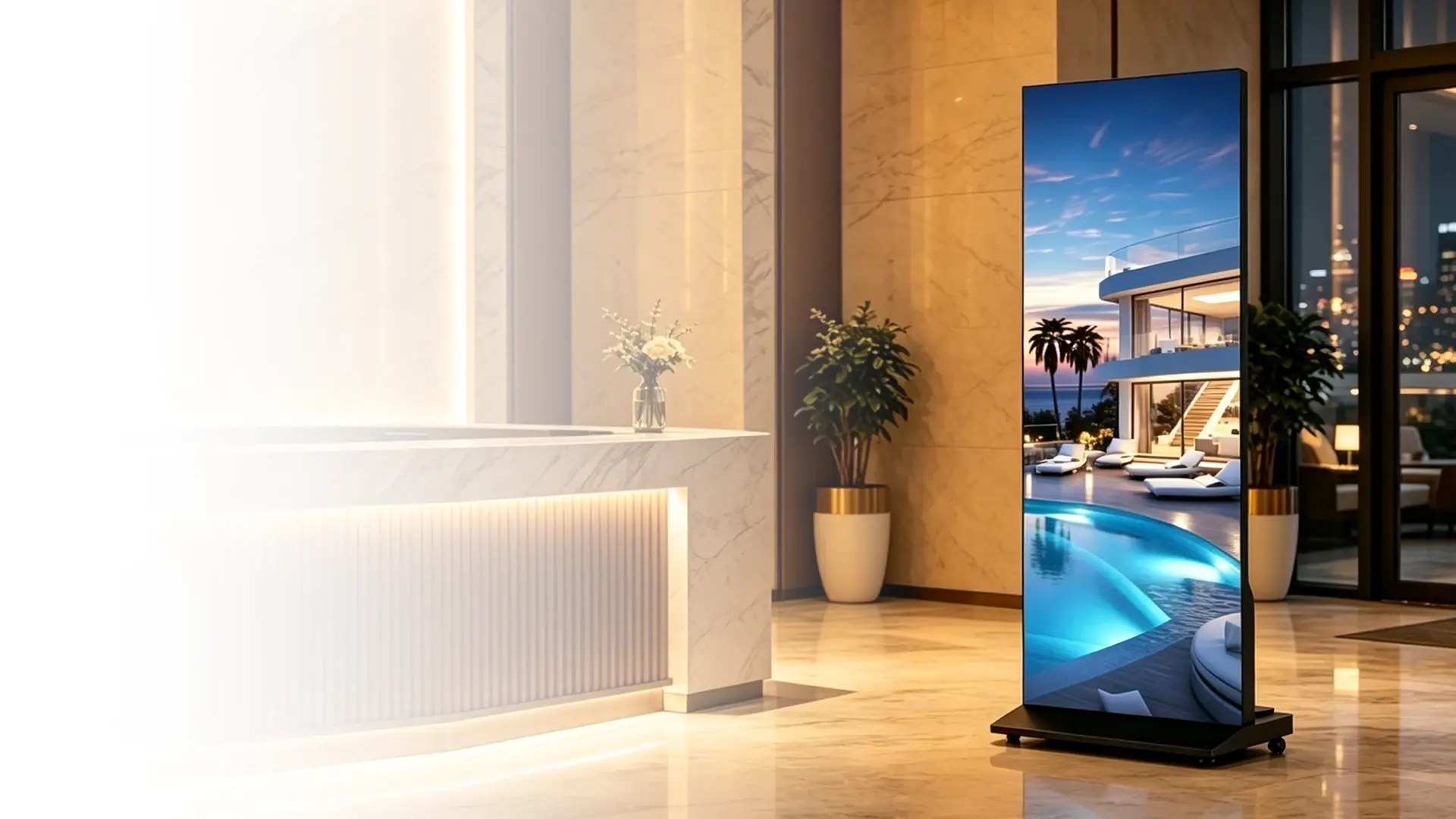
| LED Poster 70″ | 600 × 1687.5 mm | Retail windows, cafes, meeting rooms, trade-show booths |
| LED Poster 83″ | 600 × 2025 mm | Hotel lobbies, mall corridors, exhibition halls, large venues |
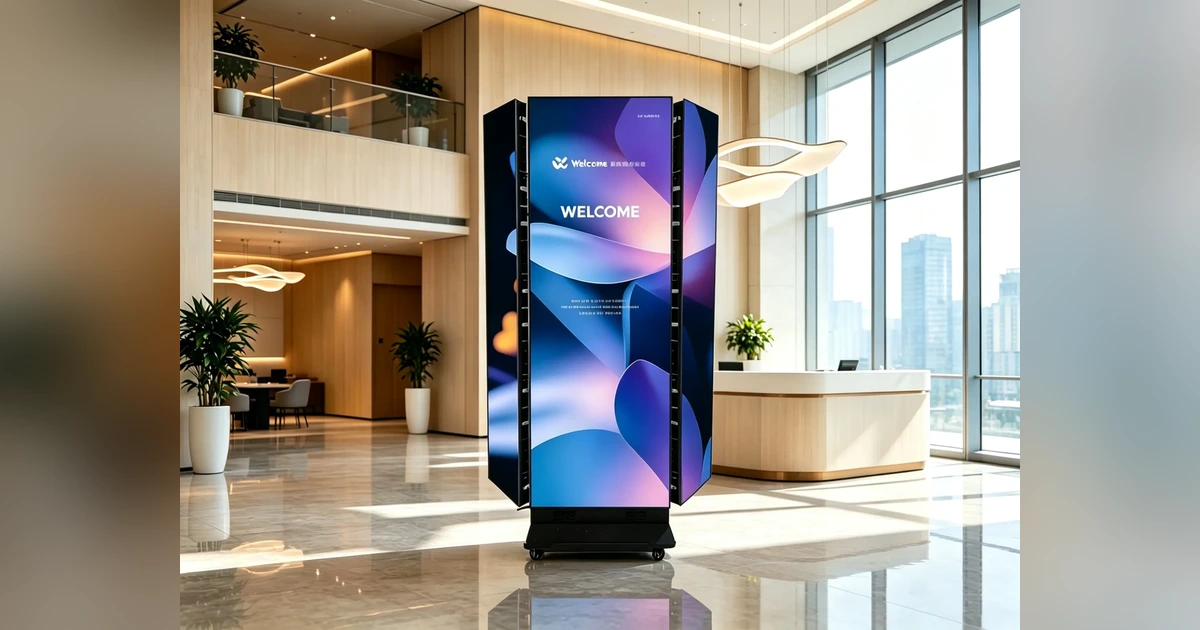
| Tri-Fold 92″ | Three-panel foldable COB | Booth backdrops and corners — folds flat for transport |
Both indoor posters keep the same 600 mm width. That is a deliberate choice: it lets a 70″ and an 83″ stand side by side in one run without a visible step, and it keeps the footprint small enough for a shop entrance. If you need a wall rather than a poster, buy more units rather than a bigger one — see splicing below.
Brightness: match it to the room, not to the number
Indoor commercial space usually needs 500–700 cd/m². Our indoor poster runs at 600 cd/m² with 5000:1 contrast, which stays readable under mall lighting without becoming painful to stand next to.
Two practical notes buyers rarely hear:
- Higher brightness is not automatically better indoors. Above roughly 800 cd/m² in a dim lobby the whites bloom, and staff ask for it to be turned down — which wastes the money spent on it.
- Contrast does more work than brightness. A 5000:1 panel at 600 cd/m² reads better than a washed-out 1000-nit panel, especially for text and price points.
Splicing: one poster or a wall
Multiple units connect vertically or horizontally with tool-free joints, up to seven units in a run. No brackets, no professional installer, minutes rather than hours. For an exhibition that means the same hardware works as a single poster on day one and as a 3×1 backdrop on day two.
Two things to check before promising a seamless wall: the joint tolerance at the module edge, and whether the content will be sent as one canvas or one player per screen. The first is mechanical and fixed; the second is a content decision that customers usually get wrong first.
Refresh rate: why 3840 Hz matters more than it sounds
Refresh rate is how many times per second the LED image is redrawn. Low-refresh panels are invisible to the eye but produce scan lines and banding the moment someone films them — which is exactly what happens at a launch event, in a short-form video clip, or on a live stream.
Our posters run 3840 Hz. If your customer’s marketing team films the screen, the footage comes out clean. On a low-refresh alternative the same footage is unusable, and no amount of post-production fixes it.
Power and heat: the number that shows up on the electricity bill
A poster that runs all day is a small but permanent cost. Ours draws ≤30 W in operation and ≤0.5 W in standby:
| Item | Per unit | 100 units, 24/7 for a year |
|---|---|---|
| Average draw | ≤30 W | 3.0 kW continuous |
| Annual energy | ≈262.8 kWh | ≈26,280 kWh |
| Cost at USD 0.15/kWh | ≈USD 39 | ≈USD 3,940 |
| Standby draw | ≤0.5 W | Negligible with daily scheduling |
Compare that with a 200 W LCD-based alternative and the difference is roughly USD 220 per unit per year at the same tariff. Over a 100-unit retail rollout that is a five-figure annual line that never appears in the purchase comparison. Fanless operation matters too — no fan means no dust intake and no noise in a library or museum.
Management: how the content actually gets there
Every Riotouch poster ships with Android 13 and DMS cloud management. In practice that means content is published from a browser or phone to one screen or to the whole network, schedules are set centrally, and device status is visible without visiting the site. A USB stick is a fallback, not the workflow.
For buyers, the question to ask is not “does it have an app” but “can I push one campaign to 40 screens in 3 cities without touching them”. If the answer requires a site visit, the total cost of ownership is already wrong.
Interfaces, touch and the AI Box / OPS slot
Standard I/O on both sizes: HDMI IN, USB 3.0 ×3, USB-B, full-function Type-C 65 W, RS232. The Type-C port carries display and power over one cable, which simplifies a demo table or a reception desk.
Optional 10-point infrared touch (1 mm precision, 2–8 ms response) turns the poster into a self-service terminal — product finder, wayfinding, queue ticket. The cabinet also carries an expansion slot for an AI Box or an OPS PC (one or the other), which upgrades a passive advertising screen into an interactive one without buying a second product.
What to put in an RFQ
Most LED poster quotes are not comparable because the specification is left open. Specify these nine points and the responses will line up:
- Pixel pitch and packaging — e.g. P1.25 COB, not just “fine pitch”.
- Brightness in cd/m² and contrast ratio.
- Refresh rate — 3840 Hz if the screen will ever be filmed.
- Active area in millimetres, not only the diagonal.
- Environment — where the unit will stand (window, mall corridor, lobby), so brightness is matched to the lighting.
- Touch: required or not, and how many points.
- Control platform — Android version and the CMS/DMS used for publishing.
- Power draw in W and standby W, plus operating temperature range.
- Packing — single carton or wheeled flight case, with CBM and gross weight.
Where LED posters go wrong in the field
Four failures come up again and again, and all four are decided at the order stage rather than at installation:
- Under-specified packaging. A poster shipped in a thin carton arrives with corner damage. Flight cases cost more and pay for themselves on the first move.
- Wrong brightness for the room. Bought at maximum output for a bright space, installed in a dim lobby, dimmed to 40% — the capability is paid for and never used.
- No remote management. After 20 units the customer is running a manual content round in a van.
- No spare modules. One dead module on a 6-unit wall is obvious. Buy 1–2 spare modules with the first order; they cost little and remove a two-week wait.
Frequently asked questions
Is a COB LED poster more expensive than SMD?
Yes, on the purchase price — typically a modest premium per unit. It is cheaper over the first three years once pixel damage, replacements and site visits are counted, which is why COB is now the default for retail, hotel and exhibition work.
Can one poster show a different image in landscape?
The 70-inch and 83-inch panels are built for vertical advertising. Landscape content can be played, but a vertical panel is the right shape for a doorway or a mall corridor, and horizontal video leaves large empty areas.
How many units can be joined into one wall?
Up to seven units vertically or horizontally with tool-free joints, giving a borderless run. Beyond that, plan a proper video wall with structural support.
What is the lifespan?
The modules are rated at 50,000 hours — about 5.7 years of continuous 24/7 operation, or well over a decade at 12 hours a day. Brightness degrades gradually rather than failing suddenly.
Can it work offline?
Yes. Content is stored on the device and plays from local storage if the network drops; DMS reconnects and re-syncs when the link returns.
Do you supply spare parts and how fast?
Spare modules, power supplies and control boards are stocked. For projects, we recommend ordering spares with the first shipment so replacements never wait on production.
The short version
Choose COB unless the deployment is genuinely low-traffic and short-term. Match brightness to the room rather than buying the highest number. Pick 70″ or 83″ by standing distance, not by budget. Buy spare modules with the first order. And specify the nine points above so the quotes you receive are actually the same product.
If you are comparing LED posters for a rollout and want the specification sheet or a price for a specific quantity, send me the venue type and unit count — I will come back with the model, the packing and the delivered cost.
Related Product
Related Articles
WhatsApp: +86 136 3170 6753
Email: julia@riotouch.com · Riotouch Technology