RK3576 Smart Boards: What the Android 16 Platform Changes
Most interactive flat panel comparisons stop at screen size, brightness and price. In a classroom the panel that still works in year four is usually the one whose Android board was specified correctly at the start, because the board decides which Android version you can run, which apps stay installable, and whether AI features run on the device or depend on a paid cloud service. This article covers the RK3576 platform as we build it into the LTF series, from 65″ to 110″, and where the RK3588 still makes more sense. It does not cover the dual-side blackboard or the foldable LED poster, which are different formats with different spec sheets.
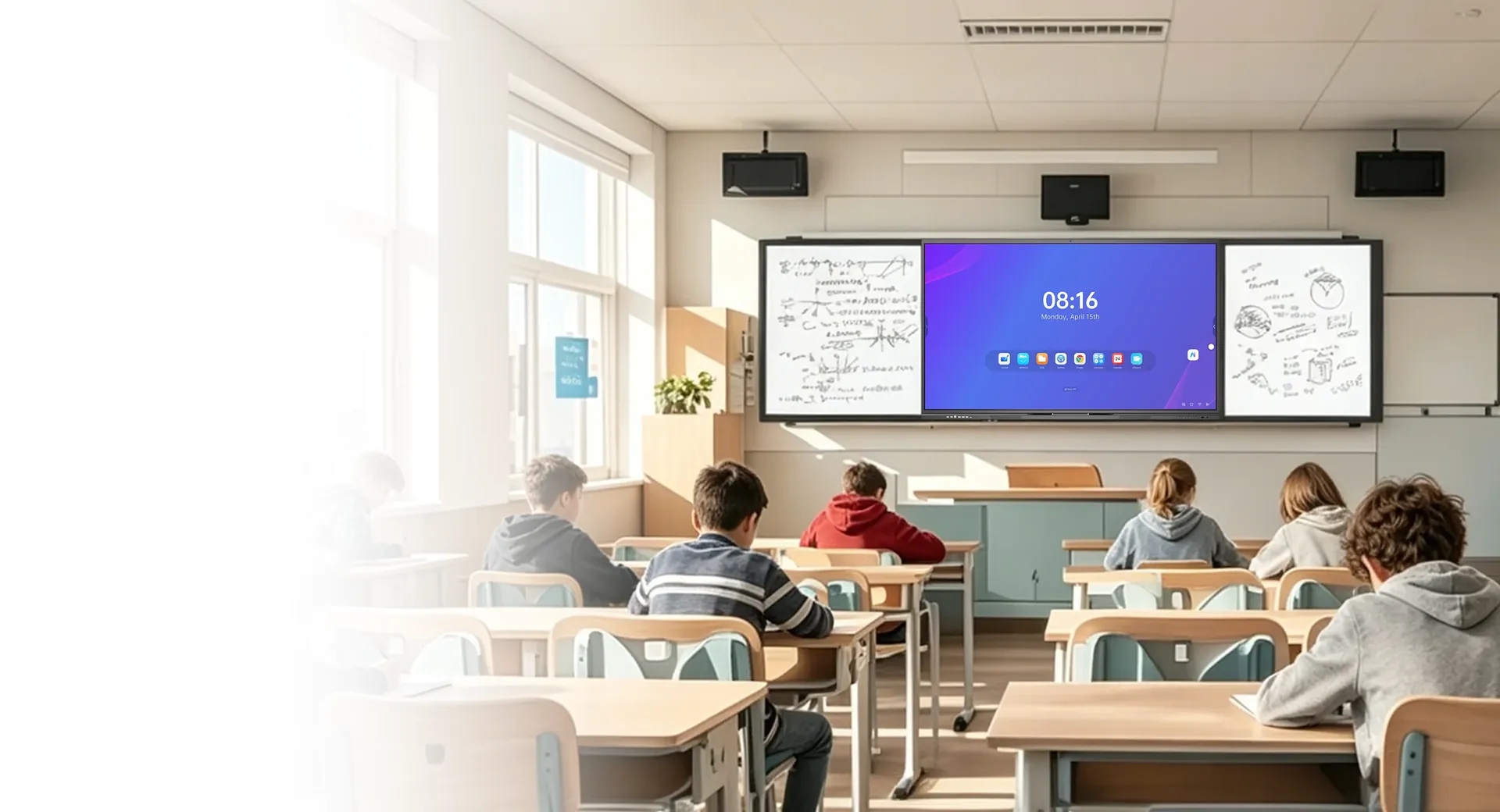
1. What the RK3576 platform is
The RK3576 is a Rockchip system-on-chip with four Cortex-A72 cores at 2.2 GHz and four Cortex-A53 cores, a Mali-G52 MC3 GPU and a 6 TOPS NPU. In our LTF series it ships with Android 16.0, 8 GB DDR4 and 128 GB of storage, with OTA updates supported.
- Android 16.0 out of the box — the current Android baseline for this class, not a carry-over 13 or 14 build.
- Eight cores: 4 x Cortex-A72 at 2.2 GHz plus 4 x Cortex-A53, with Mali-G52 MC3 graphics.
- 6 TOPS NPU on the panel itself, so handwriting, shape recognition and OCR run locally.
- 8 GB DDR4 + 128 GB storage, 4K UHD at 3840 x 2160 / 60 Hz output to the panel.

2. What actually changes in the classroom
The difference is not visible on a spec sheet side by side, because the numbers that look comparable are the ones that matter least. What a school notices is behaviour over a four-year deployment.
| What the school notices | Older Android 13/14 board | RK3576 on Android 16.0 |
|---|---|---|
| App compatibility in later years | Newer apps start dropping the older API level | Current Android baseline, plus OTA updates on the panel |
| Whiteboard writing feel | Ink lag visible on fast writing | IR touch, first point under 2 ms, continuation under 8 ms |
| AI features (handwriting, OCR, translation) | Route through a cloud service and a subscription | Run on the 6 TOPS NPU inside the panel |
| Multi-user use in one lesson | Fewer simultaneous touch points | Max 40 touch points under Windows, 20 under Android |
| Picture in bright rooms | Lower contrast panels wash out under daylight | 4000:1 contrast, anti-glare zero-bonded glass, 350 cd/m2 (450 option) |

3. Configurations that matter when you spec the panel
One platform across the range is the practical part. The LTF series on RK3576 runs 65″, 75″, 86″, 98″ and 110″ (LTF65RK3576 through LTF98RK3576, and LTDC110RK3576 for the 110″ size) with the same Android platform and the same on-screen interface, so a project mixing a 65″ classroom panel and a 98″ lecture hall panel does not turn into two support cases.
- Glass and surface: anti-glare glass with zero bonding, Mohs-7 hardness (Mohs-9 available as an option).
- Touch: infrared, 40 points under Windows and 20 under Android, 1 mm precision over 90% of the area.
- Display: 3840 x 2160 at 60 Hz, 4000:1 contrast, 178 degree viewing angle, 1.07 billion colors, 50,000 hour lifespan.
- Audio: 15 W x 2 front speakers as standard, 20 W x 2 and a 20 W subwoofer as options, 8-microphone array optional.
- Options: 48 MP AI camera, NFC reader/writer, fingerprint module, black, white or custom frame color.
- Power: maximum 290 W (65″), 320 W (75″), 350 W (86″), 510 W (98″) and 750 W (110″), with an eco mode under 75 W.
- OPS slot: confirm this per model with your project engineer before quoting a Windows OPS configuration — it is not listed on every LTF spec sheet revision.
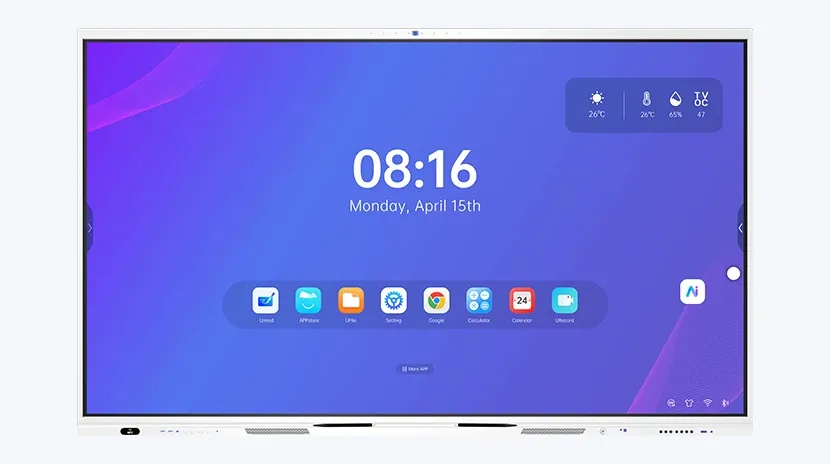
4. RK3576 or RK3588 — both are available, they are not the same purchase
We build both platforms. The difference is headroom, not generation: RK3588 buys more CPU and GPU, RK3576 buys a newer Android baseline at a lower cost per unit. Neither one is “the good one”.
| Specification | LTF RK3576 series | LTF RK3588 3.0 series |
|---|---|---|
| Android version | Android 16.0 | Android 15.0 |
| CPU | 4 x Cortex-A72 @ 2.2 GHz + 4 x Cortex-A53 | 4 x Cortex-A76 + 4 x Cortex-A55 |
| GPU | Mali-G52 MC3 | Mali-G610 MC4 |
| NPU | 6 TOPS | 6 TOPS |
| Contrast / brightness | 4000:1 · 350 cd/m2 (450 option) | 1200:1 static, 4000:1 dynamic · 400 cd/m2 |
Two constraints worth writing into the quotation: the platform and the memory configuration are fixed at order and cannot be upgraded on site, and the Android version a panel ships with is what the software team tests against — if a customer needs a specific Android API level, confirm it before the order, not after delivery. The RK3576 datasheet lists the configurations we ship.
5. On-device AI, and when it is actually useful
A 6 TOPS NPU is only worth paying for if the features a teacher uses every day run on it. In practice that means handwriting and shape recognition in the whiteboard, math graphing, OCR of a photographed worksheet, and split-screen comparison — all of which work without a network connection once the panel is set up.
What it does not replace is the software layer on top. Our panels ship with the UMind whiteboard, UFile file management, a cloud platform and MDM remote control, and OEM customers can replace the on-screen interface with their own. Test the apps your teachers actually use on a sample unit: NPU throughput is a specification, but lesson-time behaviour is what gets complained about.

6. Before the order
- Confirm the Android version the customer's software stack is certified against, and check whether a specific Google build is required for the project.
- Confirm the OPS slot on the exact model and size being quoted if a Windows OPS module is part of the scope.
- Ask for the delivery room conditions — a 350 cd/m2 panel is specified for indoor use; brightness and glass options change the quote.
- Decide the camera and microphone configuration up front (48 MP camera, 8-microphone array), because retrofitting changes the bezel and the lead time.
- Check the power budget per room: 350 W for an 86″ unit is a real load when a school installs thirty of them.
- Request the spec sheet revision number you are quoting against, so a later revision does not silently change the comparison. The published specifications are the reference.
7. FAQ
Is RK3576 newer than RK3588?
No. RK3576 and RK3588 are different Rockchip platforms built for different price points. RK3576 runs a newer Android baseline (Android 16.0 in our LTF series) with 4 x Cortex-A72 and Mali-G52 MC3; RK3588 offers more CPU and GPU headroom with 4 x Cortex-A76 and Mali-G610 MC4 on Android 15.0. Both carry a 6 TOPS NPU.
Which sizes are available on RK3576?
The LTF RK3576 series covers 65″, 75″, 86″ and 98″ (LTF65RK3576 to LTF98RK3576) plus the LTDC110RK3576 for 110″. All sizes share the same Android platform and on-screen interface.
Does the panel need a cloud subscription for AI features?
Handwriting, shape recognition, OCR and graphing run on the on-panel NPU. Management features such as MDM remote control depend on the software platform the customer chooses, not on the panel hardware.
Can we use our own brand and interface?
Yes — OEM and ODM are standard for us: custom frame color, custom boot logo and on-screen interface, and packaging under the customer's brand.
What should we compare first when two quotes differ?
Compare the Android version, the SoC, the memory configuration, the touch specification (points, precision, response time) and the glass treatment. Panel size and brightness are the easiest numbers to match and the least useful on their own.
Related Product
RK3576 Interactive Flat Panel
LTF series on Android 16.0, 65″ to 110″, IR touch, 6 TOPS NPU, UMind whiteboard built in.
View Product →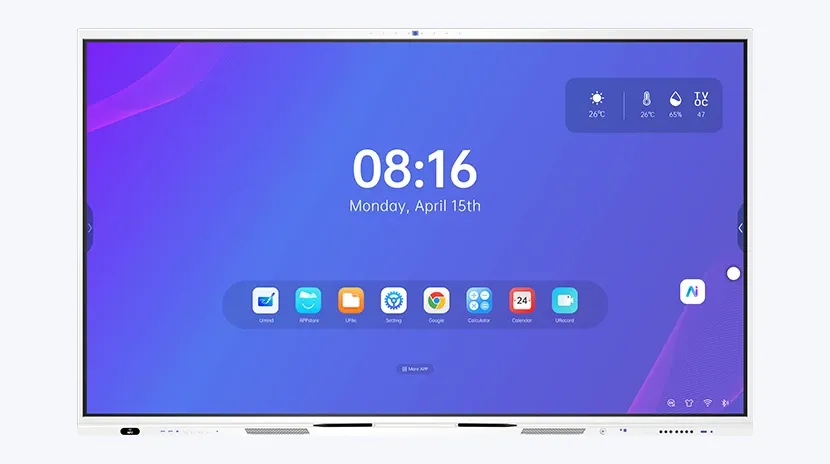
RK3588 Series
Same LTF form factor with 4 x Cortex-A76 and Mali-G610 MC4 when the project needs more headroom.
View Product →
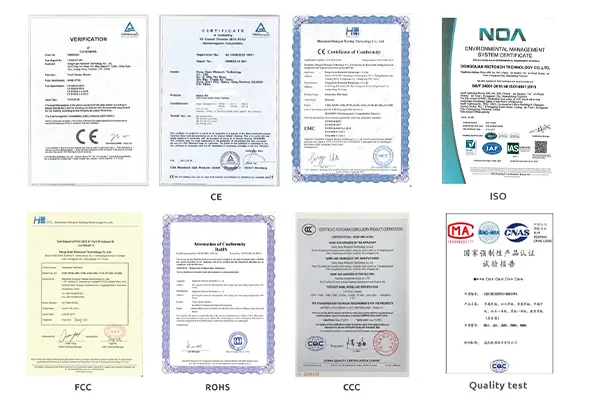
Specs & Certifications
Published specifications and certificate revisions for every model, so a tender comparison stays comparable.
View Specifications →Related Articles
Jason Dai — Sales Manager
Dong Guan RioTouch Technology Co.,Ltd.
Email: jasondai@riotouch.com
WhatsApp: +86 177 7154 3836