Why New Android Versions Take Longer to Reach Interactive Displays
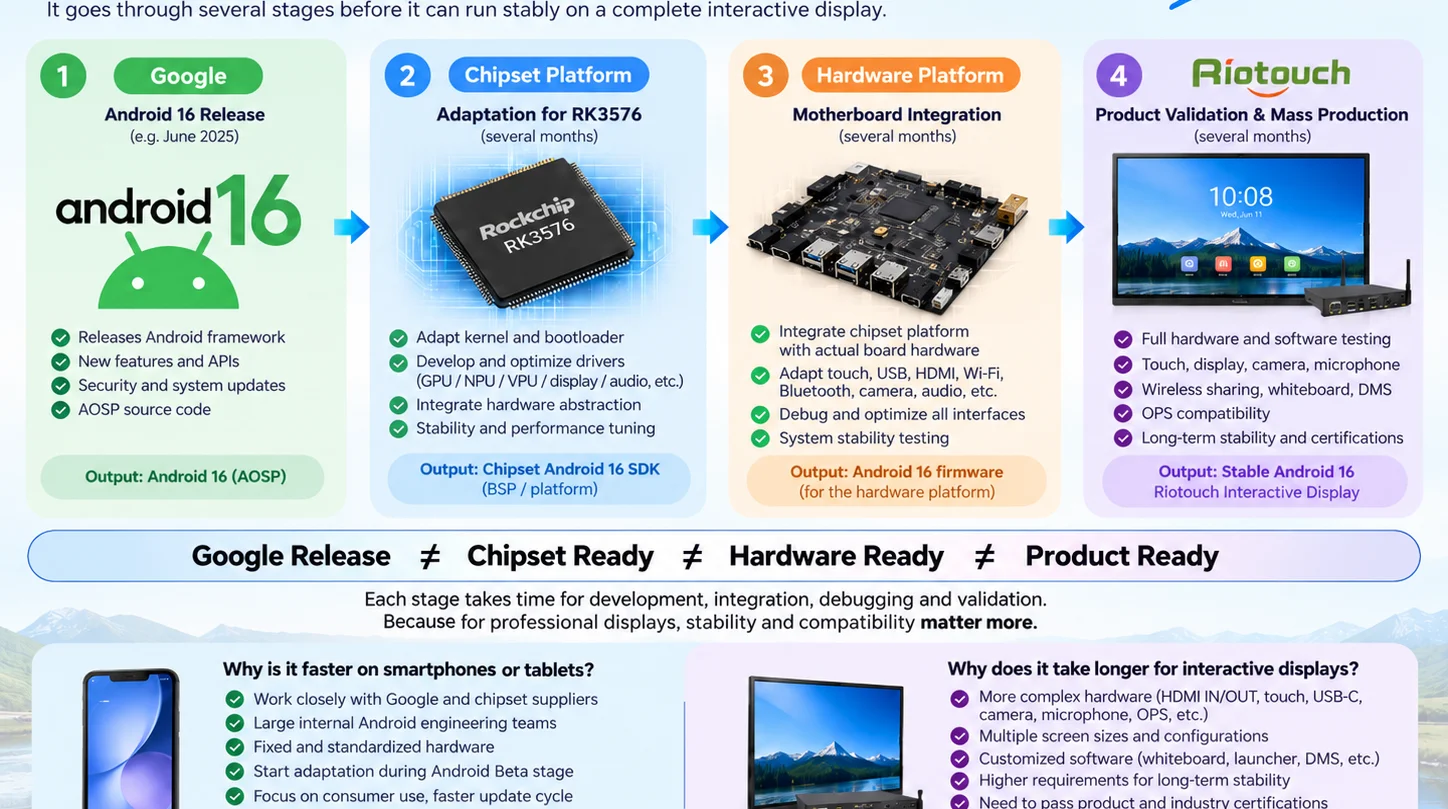
Understanding the path from Google’s Android release to a stable, production-ready professional display.
When Google releases a new Android version, customers often expect it to appear immediately on every Android-based device. In professional interactive displays, however, the public Android release is only the first step. The operating system must still be adapted to the chipset, integrated with display hardware and validated across touch, video, audio, connectivity, OPS and software before it is ready for mass production.
Android 16 Is Released. Why Isn’t Every Interactive Display Ready on Day One?
Android is used across an enormous range of products, from smartphones and tablets to televisions, automotive systems, kiosks and professional interactive displays. That variety is one of Android’s greatest strengths, but it also means that a new Android version does not reach every hardware category at the same time.
Android 16 reached stable release in June 2025. For a phone user, that can sound like the finish line. For a professional display manufacturer, it is closer to the starting signal: the platform must still move through several engineering layers before it becomes a stable production image for a complete interactive display.
The Four-Stage Release Path
Only after these layers are completed can a new Android version become suitable for stable mass production and commercial deployment.
| Stage | What happens |
|---|---|
| 1. Google — Android Platform Release | Google publishes the Android platform, APIs, framework changes, security architecture and AOSP components. This establishes the software foundation, but it is not yet a finished firmware image for a specific commercial display. |
| 2. Chipset Platform — SoC Adaptation | The chipset platform is adapted for the new Android version. Kernel, bootloader, graphics, video, audio, hardware acceleration, power management and low-level drivers must work correctly on the target processor. For this article, RK3576 is a useful public example of this layer. |
| 3. Hardware Platform — Board and Interface Integration | The chipset software is then integrated with the actual display hardware platform. HDMI input/output, USB, USB-C, Wi-Fi, Bluetooth, touch, cameras, microphones, audio, LAN, control interfaces and other peripherals all need to operate correctly under the new OS. |
| 4. Riotouch — Complete Product Validation | The final system is validated as a complete Riotouch product. This includes touch behavior, panel compatibility, video and audio, camera and microphone functions, wireless sharing, whiteboard software, device management, OTA updates, OPS interoperability, multilingual UI and long-term stability testing. |
Why Can Smartphones and Tablets Move Faster?
Customers naturally compare an interactive display with a smartphone because both may run Android. But the development model is very different.
In short: a smartphone update mainly has to make one tightly controlled consumer device work well. A professional interactive display has to make an entire hardware-and-software ecosystem work reliably together.
What Has to Be Revalidated After a Major Android Upgrade?
A version change can affect much more than the Android home screen. Depending on the platform, engineers may need to retest or optimize:
- Touch accuracy, multi-touch behavior and pen interaction
- HDMI input/output, resolution switching and HDCP-related behavior
- USB and USB-C data, touch-back, display and charging functions
- Camera, microphone array, audio routing and echo-control behavior
- Wi-Fi, Bluetooth, LAN and wireless screen-sharing compatibility
- OPS switching and interoperability between Android and Windows
- Whiteboard, launcher, app compatibility, DMS and OTA functions
- Power management, standby/wake behavior, stability and recovery
- Multiple panel sizes, regional configurations and certification requirements
Why Riotouch Prioritizes Stability Over the Version Number
For commercial buyers, the newest Android version is valuable only when the complete product is dependable. A demo firmware that boots successfully is not the same as production-ready firmware.
Before a new OS is used widely in classrooms, meeting rooms or enterprise deployments, it should be tested as a complete product rather than only as a chipset or motherboard image. That is why a responsible commercial rollout can take longer than the Android release timeline seen on consumer phones.
What Buyers Should Ask When Evaluating a “Latest Android” Interactive Display
Instead of asking only “What Android version does it use?”, a better evaluation includes:
- Is the firmware already production-ready, or is it an early/demo build?
- Have touch, camera, microphone, HDMI, USB-C and OPS functions been fully validated?
- Is there a stable OTA/update path for deployed units?
- Are whiteboard, screen-sharing and management applications compatible with the new OS?
- Has the configuration been tested across the actual sizes and hardware options being purchased?
- What support is available if an OS-level compatibility issue appears after deployment?
These questions give a much better picture of product maturity than the Android version number alone.
Riotouch’s Approach: New Platform, Complete Validation
Riotouch develops interactive display solutions for education, business and commercial environments, with platforms that combine Android, touch interaction, display hardware, OPS computing, collaboration software and remote device management.
When introducing a new Android platform such as Android 16 on RK3576-based products, our focus is not simply to make the new version appear in the specification sheet. The goal is to make sure the complete product experience is stable, compatible and ready for long-term deployment.
That is the difference between “Android 16 can run” and “Android 16 is ready for a professional interactive display.”
Frequently Asked Questions
Does Google releasing Android 16 mean every Android device can update immediately?
No. Google’s platform release is only the software foundation. Each chipset, hardware platform and finished product still needs its own adaptation, integration and validation before the new OS is suitable for production.
Why is an interactive display more complex to upgrade than a tablet?
A professional interactive display combines touch, HDMI, USB-C, cameras, microphones, wireless sharing, OPS computing, whiteboard software, device management and multiple panel configurations. These systems need to remain compatible after the Android upgrade.
Is a newer Android version always better for a commercial deployment?
A newer platform can bring important features, APIs and security improvements, but commercial value depends on maturity. For schools, meeting rooms and enterprise projects, stable firmware, peripheral compatibility and a reliable update path are just as important as the version number.
Contact Riotouch
Interested in Android 16 interactive displays, RK3576 platforms, OEM/ODM customization or project-based solutions? Talk with Riotouch about the right configuration for your market or project.
Contact: Barry Chen
Email: barry@riotouch.com
WhatsApp / Tel: +86 155 2706 5860
Website: www.riotouch.com
Technology for a Smarter, More Connected World
Related Articles
Need a Solution That
Fits Your Project?
Tell us what you're looking for and we'll tailor a quote to your requirements — with pricing, lead time, and expert advice.