Why Motorized TV Stands Are Changing the Way Classrooms and Meeting Rooms Work
A practical guide to electric flip stands and height-adjustable stands for interactive flat panels — and what to look for before you buy.
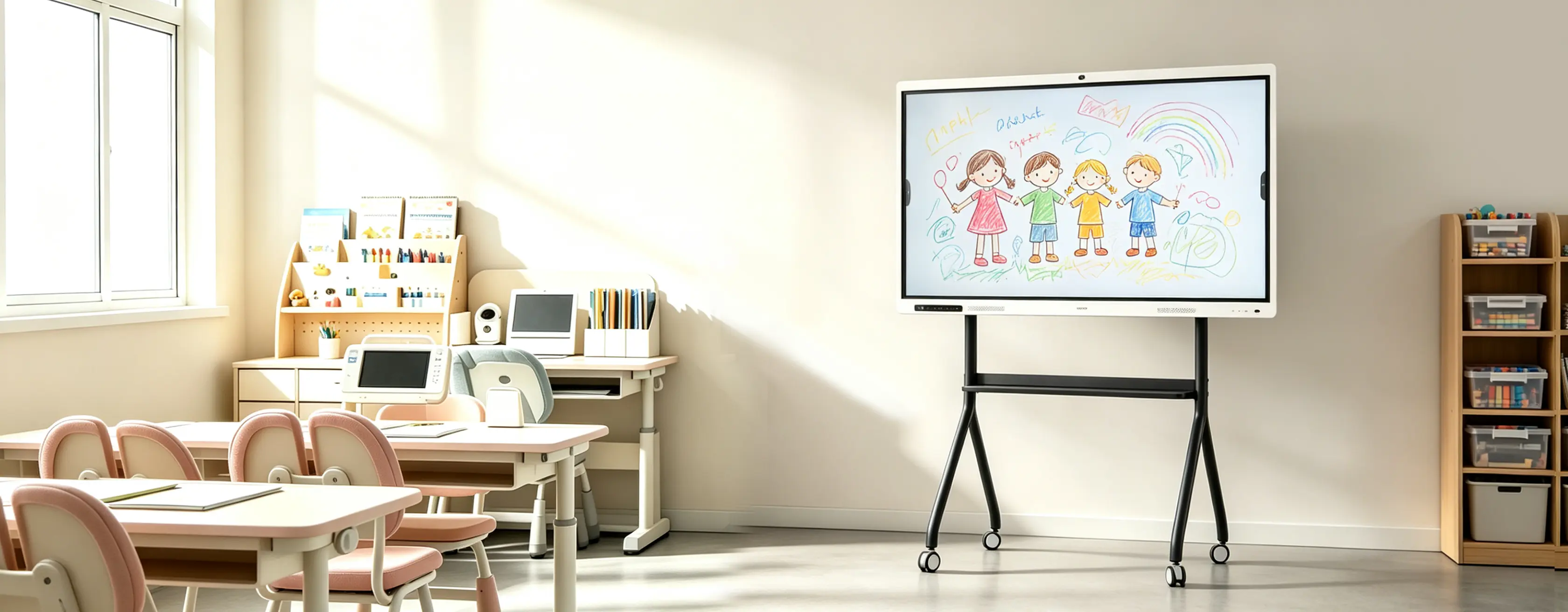
If you’ve ever watched a teacher strain to tilt an 86-inch interactive panel by hand, or seen a meeting room scramble to adjust a display that was mounted for someone six feet tall, you already understand the problem motorized TV stands solve.
Interactive flat panels (IFPs) have become the default display technology in classrooms, boardrooms, and training centers. But the stands underneath them haven’t always kept up. Fixed stands lock the screen into a single position. Manual stands demand physical effort every time the layout changes. And when a display needs to serve a room of different people — different heights, different teaching styles, different tasks — “good enough” positioning quickly stops being good enough.
That’s where electric stands come in. In this article, we’ll break down the two main types of motorized TV stands, the environments they serve best, and the specs that actually matter when you’re comparing options.
The Two Types of Motorized TV Stands
Broadly, electric stands fall into two categories, each solving a different problem.
1. Electric Flip Stands (like the Riotouch EFL72)
A flip stand motorizes the angle of the screen. The EFL72, for example, rotates the panel a precise 90°±1° at the touch of a button — smoothly switching the display between vertical and horizontal orientations.
Why does that matter? Because different tasks want different orientations:
- Presentation mode — the screen stands upright for slides, video, and remote collaboration.
- Writing mode — the panel rotates to a horizontal drafting position, so students and teachers can write comfortably at the screen instead of reaching across a vertical display.
- Maintenance mode — flipping the panel flat makes installation, cabling, and servicing dramatically easier than working on a wall mount.
For classrooms, this one-touch flip is the standout feature. Instead of two people physically lifting and repositioning a heavy panel between activities, the teacher presses a button and moves on with the lesson.
2. Electric Height-Adjustable Stands (like the Riotouch EL73)
A height-adjustable stand motorizes the elevation of the screen. The EL73 travels through a 1200–1700 mm lifting range, so the display can sit at the right height for a kindergartner in the morning and an adult training session in the afternoon.
This matters most in multi-user spaces: corporate meeting rooms, training centers, and shared facilities where no single mounting height works for everyone. It’s also a genuine accessibility feature — wheelchair users and seated participants get an optimally positioned screen instead of one designed for standing presenters.
The Specs That Actually Matter
Marketing pages love bullet points. But when you’re evaluating a motorized stand for a real deployment, here’s what to check:
| Key spec | What to look for |
|---|---|
| Load capacity | EFL72 rated to 120 kg — headroom for 86″ panels (which often weigh 60 kg+ alone); EL73 supports up to 110 kg. Leave headroom. |
| VESA compatibility | Universal 800×600 mm pattern with vertical adjustability — fits 99%+ of mainstream 65″–86″ IFPs. |
| Height and flip range | 1200–1700 mm adjustment (EL73) covers seated to standing use; 900–1700 mm overall range (EFL72) covers classroom ergonomics plus flip. |
| Noise level | Low-noise motors designed for quiet classrooms and video calls. |
| Mobility | Silent PU casters, 360° swivel, four-wheel brake locks so the stand stays planted. |
| Build material | Cold-rolled steel, dual-column construction, corrosion-resistant finish, anti-tipping wide base. |
Load capacity. An 86-inch interactive panel is heavy — often 60 kg or more on its own. The EFL72 is rated to 120 kg (265 lbs), with the EL73 supporting up to 110 kg. A stand that’s barely rated for your panel is a stand that will fail prematurely. Leave headroom.
VESA compatibility. The mounting pattern on the back of your panel has to match the stand. Both Riotouch stands use a universal 800×600 mm VESA pattern with vertical adjustability, which fits over 99% of mainstream 65″–86″ panels. If you’re buying stands for a mixed fleet of displays, this is the spec that saves you from a bracket nightmare.
Height and flip range. Match the range to your room. A 1200–1700 mm adjustment covers seated to standing use for most adults; a 900–1700 mm overall height range (EFL72) covers classroom ergonomics plus flip functionality.
Noise level. A loud motor in a quiet classroom or during a video call is a daily annoyance. Look for stands specified with low-noise motors — both EFL72 and EL73 are designed for quiet operation in exactly these environments.
Mobility. If the stand will move between rooms, check the casters. Silent PU wheels roll smoothly over carpet, tile, and hardwood without scratching, swivel 360° for flexible positioning, and — critically — include brake locks so the stand stays planted once positioned.
Build material. Cold-rolled steel, dual-column construction is the standard for heavy panels. It resists flex and wobble, and a corrosion-resistant finish keeps the stand presentable after years of use. An anti-tipping wide base isn’t glamorous, but it’s the difference between a stable display and a liability.
Where Electric Stands Earn Their Keep
Smart classrooms. The one-button flip between presentation and writing modes changes teaching dynamics. Teachers stop planning lessons around the limitations of their display hardware and start using the panel the way it was designed — as a true interactive surface at whatever angle the activity demands.
Corporate meeting rooms. Height-adjustable stands let a single room serve stand-up briefings, seated video conferences, and collaborative sessions without compromise. Rooms get reconfigured in seconds, not maintenance tickets.
Training centers and exhibition halls. Mobility is king here. A heavy panel on silent-locking casters can roll between training rooms or across a trade show floor, then lock firmly in place for a stable, professional presentation. For exhibitors, a motorized stand turns one display into a versatile showpiece.
Electric vs. Fixed: What Changes in Practice
| Motorized stands (EFL72 / EL73) | Generic fixed stands | |
|---|---|---|
| Adjusting the display | One button | Manual lifting / remounting |
| Multi-user ergonomics | Adapts to every height and task | One fixed position |
| Room reconfiguration | Seconds, no tools | Maintenance call |
| Total cost over time | Lower when layouts change often | Higher when workarounds add up |
Real-World References
Ask for deployments similar to yours. Riotouch’s electric stands are used across 80+ countries — including 300+ units across Southeast Asian classrooms and 150+ units in Middle East training centers — which speaks to both scale and reliability.
The Bottom Line
The interactive panel gets all the attention, but the stand underneath determines whether that panel actually adapts to the people using it. A motorized flip stand turns a vertical display into a genuine writing surface. A height-adjustable stand turns a fixed installation into an inclusive one. And when both come with universal VESA mounting, heavy-gauge steel, and lockable casters, they turn into infrastructure that just works — year after year, room after room.
For classrooms, boardrooms, and training facilities planning their next display rollout, the case for going electric is simple: the screen should adjust to the user, not the other way around.
Explore Riotouch Motorized TV Stands
The EFL72 motorized flip stand and EL73 electric height-adjustable stand — for 65″–86″ interactive panels, with OEM/ODM support, CE/FCC/RoHS certification, and worldwide shipping.

Related Articles
WhatsApp: +86 190 2675 1657
Sales Team · Riotouch Technology