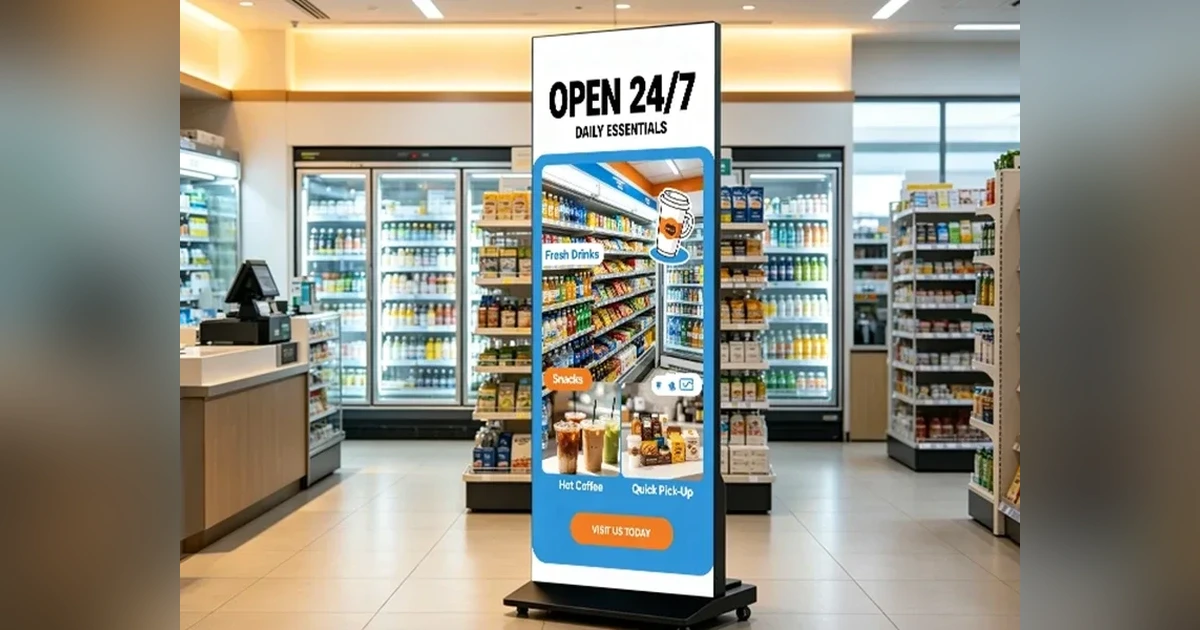
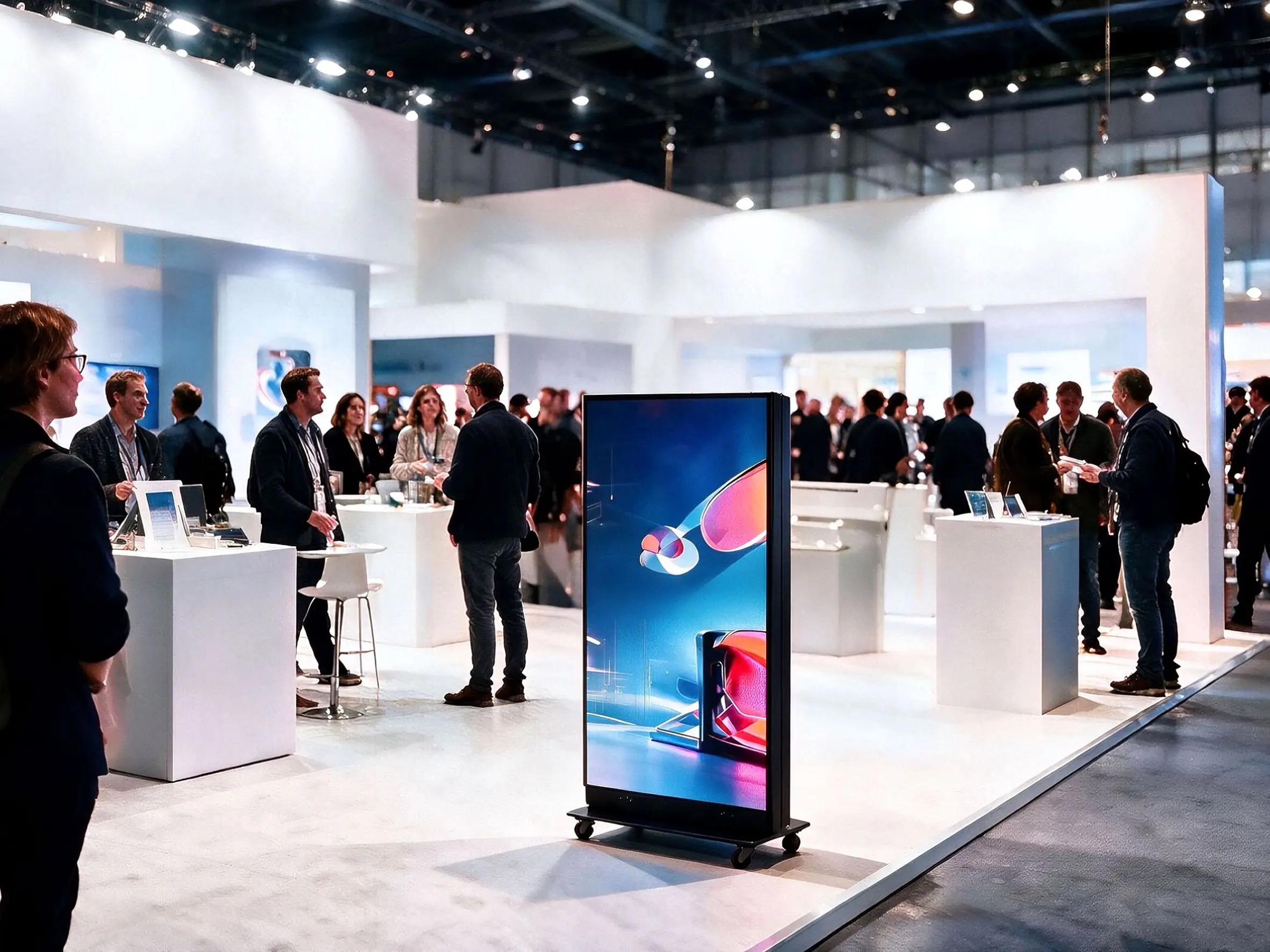
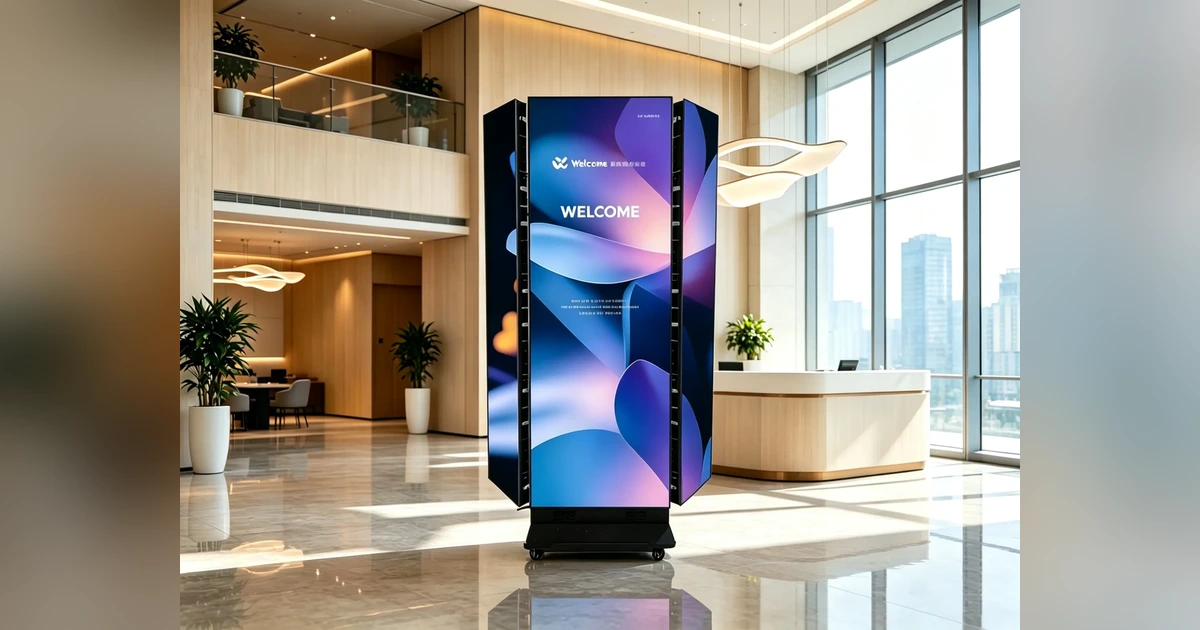
Most LED displays underperform for reasons that have nothing to do with the panel. The screen is bought, installed, and then runs the same loop of stock footage for eighteen months, because commissioning a new ad means a designer, a brief, a file and somebody to load it. At the 140th Canton Fair, on stand 19.2K23-24, we ran the opposite setup: a QR code on the stand, no laptop, and no artwork prepared in advance. This is what four visitors produced on it, and why it matters to anyone selling screens into shops.
1. Four inputs, four finished campaigns
None of the four arrived with a design file. Two were visitors who had stopped to look at the LED poster and were handed a phone instead of a brochure. The compressor case is the one dealers react to: a single photograph became a month of material, because the platform did not need the client to describe what the campaign should say — it read the product and wrote around it.
| What the visitor supplied | What came back | Where it played |
|---|---|---|
| A spoken sentence, in Spanish | A tourism poster for Bolivia, copy and layout written by the AI, returned in about thirty seconds | LED poster, on the stand |
| One product photo, then the words “cinematic style” | A studio shot carrying the brand line and price, plus a cinematic variant | LED Digital Podium, within a couple of minutes |
| One photo of an air compressor | A three-page campaign built around range, performance and durability, each page with its own headline and layout | Rotating on the same screen |
| A skincare brand’s website URL | A cinematic visual in the brand’s own colours, then a softer second variant on request | LED poster, next to the first |
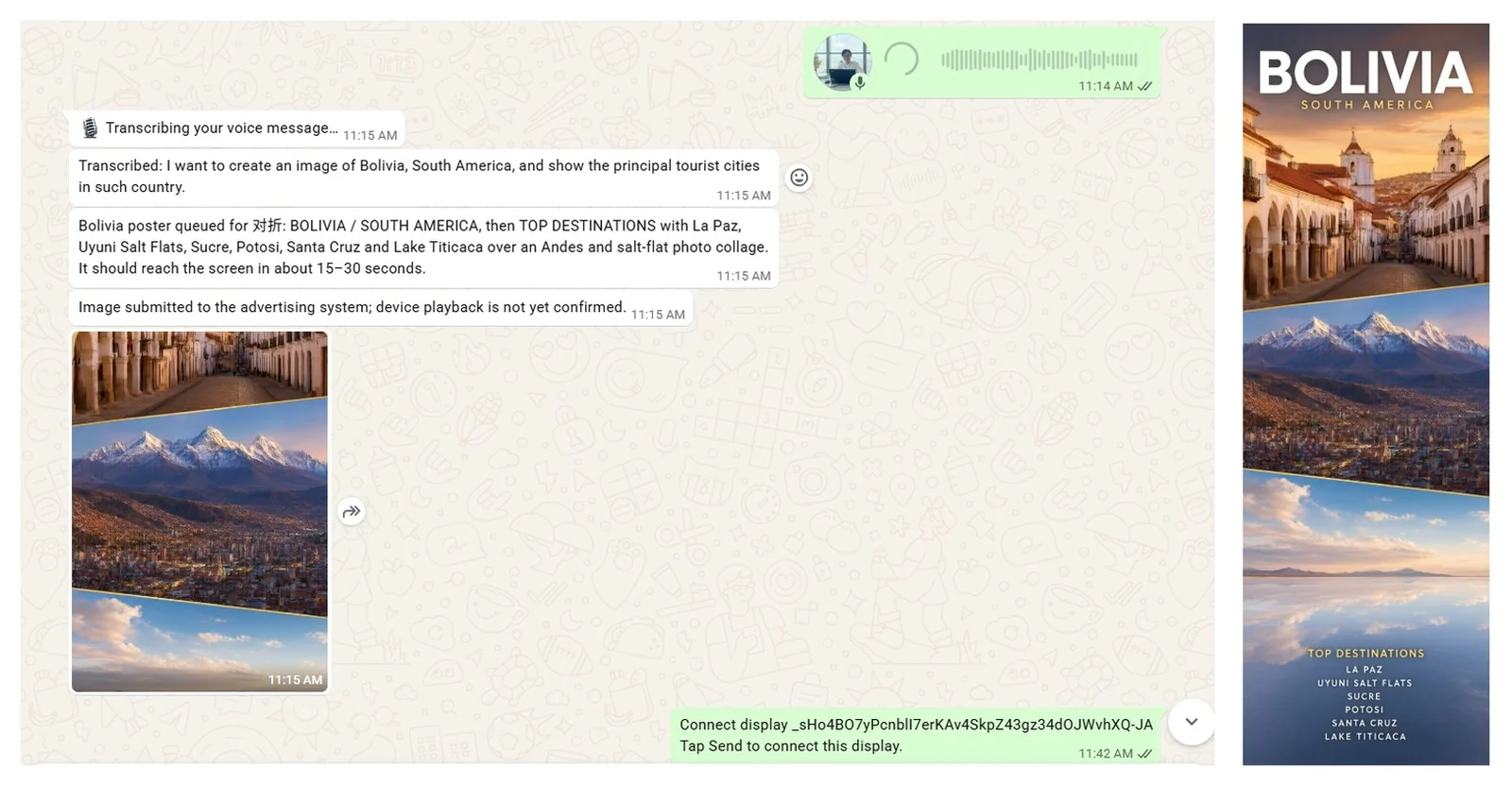
Example 1 — Left: the WhatsApp thread on the booth phone, where a visitor asked for a Bolivia tourism poster. Right: the poster the AI returned, in about thirty seconds.
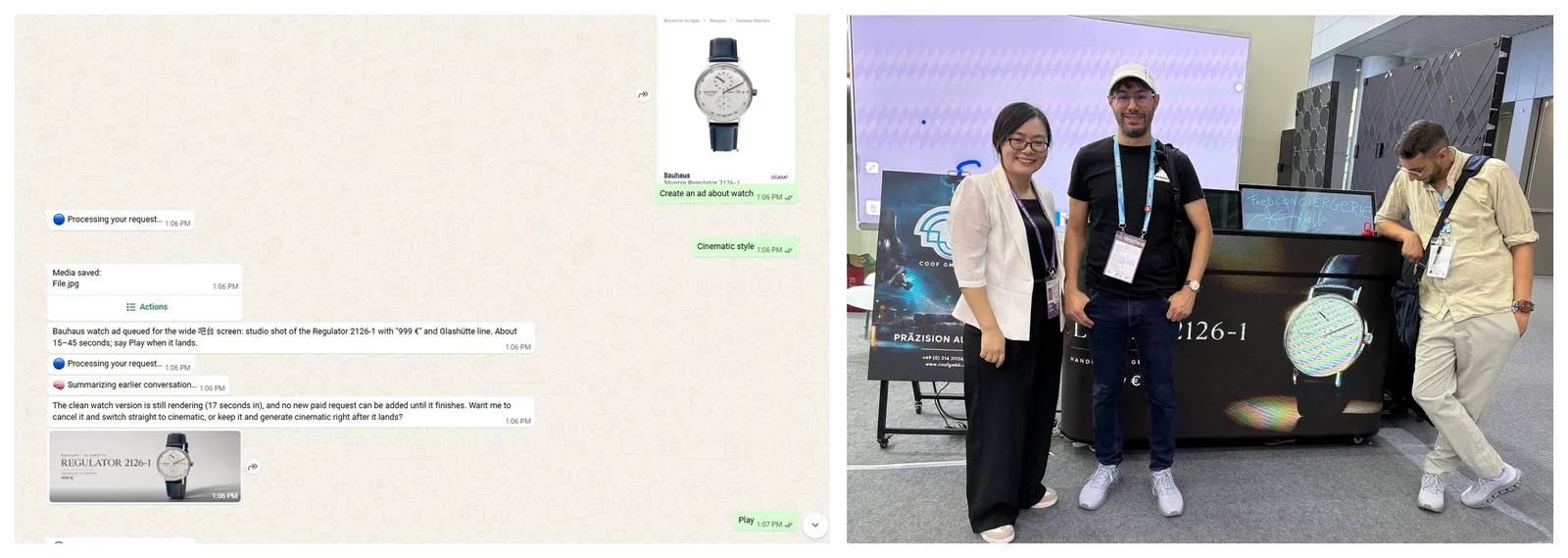
Example 2 — Left: one product photo plus the words “cinematic style”. Right: the finished ad playing on the LED Digital Podium while the visitor checks his phone.
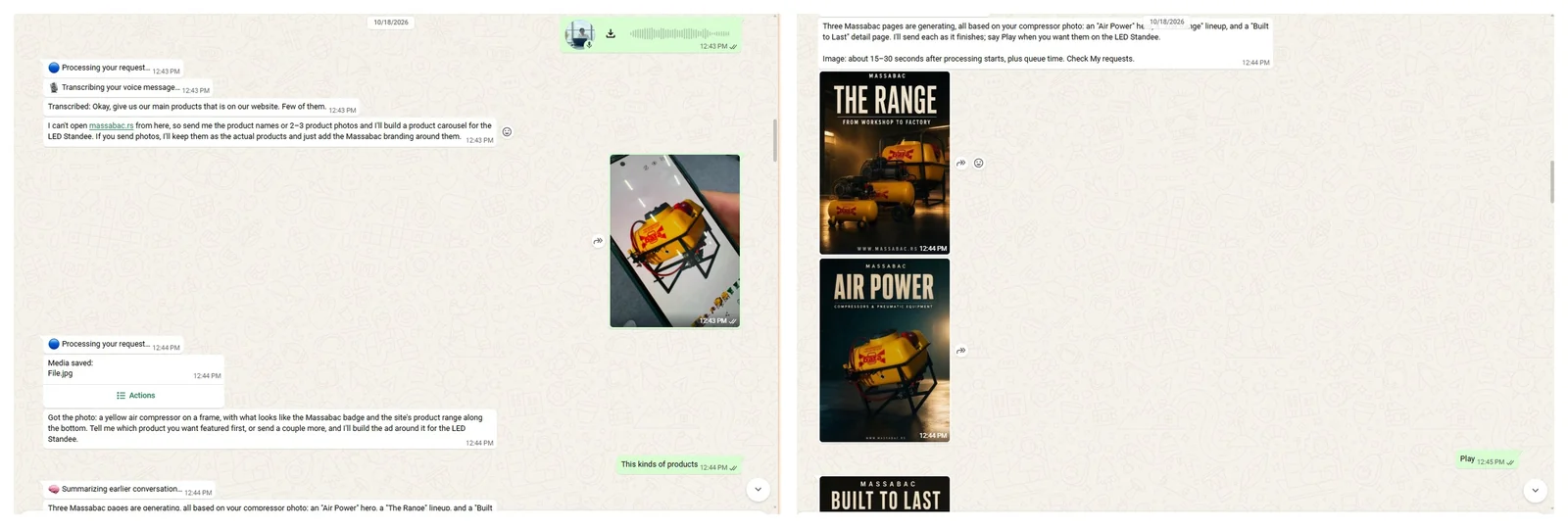
Example 3 — Left: a single photo of an air compressor. Right: the three-page campaign the AI built around range, performance and durability.
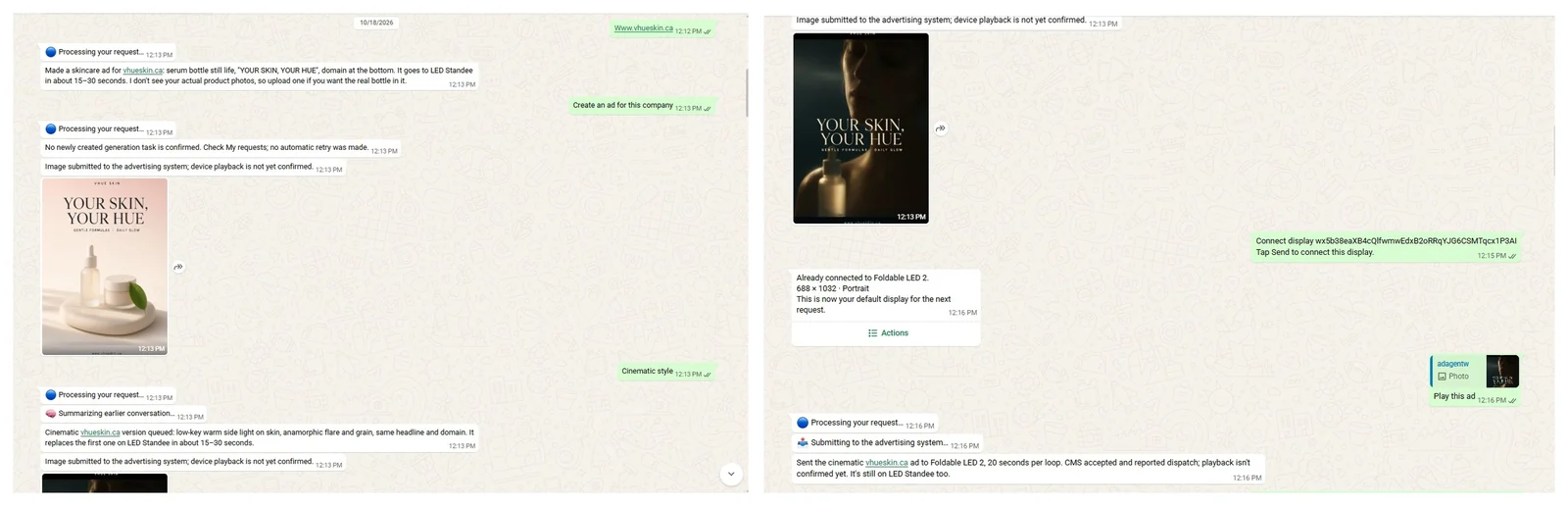
Example 4 — Left: nothing supplied but a skincare brand’s URL. Right: the cinematic spot in the brand’s own colours, plus the variant requested after it.
2. What replaced the design brief
Three steps, and the client does all three from the phone already in their hand.
- Scan the QR code on the screen or on the stand. No app, no account, no laptop.
- Say what you want, by typing or speaking, in your own language — for example, “a summer sale poster for my shop”.
- The ad appears. It is generated and published in one to two minutes.
The conversation runs over WhatsApp, Facebook, Telegram or a browser — whichever the client already uses. That detail matters commercially: nobody has to be taught a new interface before they can publish to the screen they just bought.
3. What this changes for the reseller
The economics of a display sale usually end at the invoice; the customer then discovers that content, not hardware, is the recurring cost. With the CMS attached to the screen, the daily promotion loop stops waiting on artwork files. A shop changes the message the same morning, at the same cost, and multi-language is built in — the client speaks, the AI writes in that language. In a chain, every screen can carry its own content and still be managed from one place.
What it removes, in the client’s own terms: no graphic designer for day-to-day promotion, no agency brief, no waiting for a file, no USB stick, no player software to install, and no print run each time the offer changes.
4. The four formats it runs on
The content system is identical across the range, so a campaign is never tied to one device. Choose the screen that fits the space.
| Format | What it is | Where it goes |
|---|---|---|
| LED poster — KI 92 | 92″ foldable, GOB P1.86, 1280 × 1920 mm; folds for transport, stands free | Windows, lobbies, showrooms |
| LED poster — 45.4″ single cabinet | 645 × 965 × 38.8 mm, 18.5 kg, VESA standard; hangs or stands | Retail aisles, menus, small windows |
| LED Standee | Floor-standing advertising unit on the same content system | Entrances, event floors, product launches |
| LED Digital Podium | Curved lectern-format screen | Showrooms, conference foyers, flagship stores |
All four are indoor formats. Neither the poster range nor the podium is offered as an outdoor or semi-outdoor unit, and we do not quote them for direct-sunlight positions.
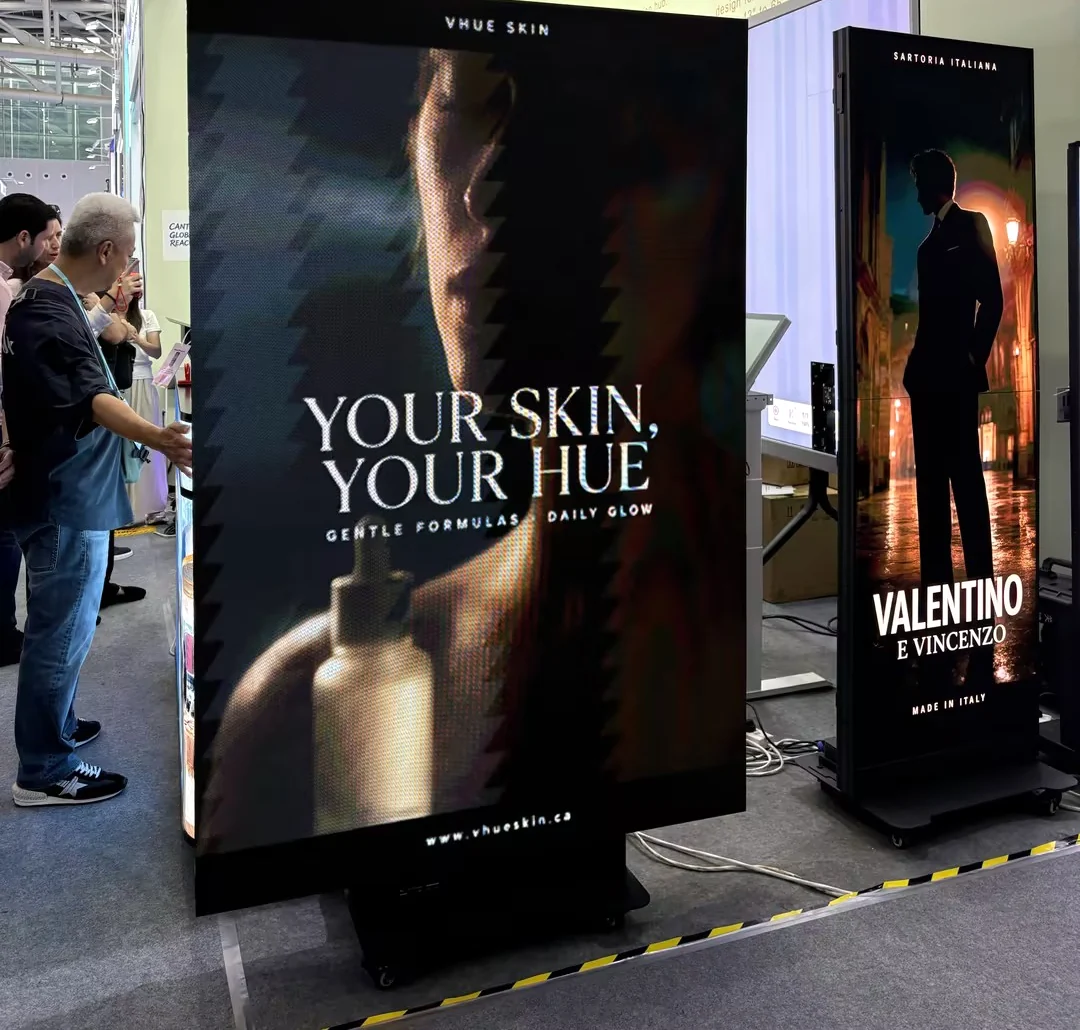
Two LED posters side by side on the stand, running separate campaigns from the same CMS — the left one generated on site from a shampoo brand’s website.
5. Where the CMS stops
Two limits are worth stating before anyone demos this to a client. First, it replaces the day-to-day promotional loop, not brand work: logo files, typography rules and product photography still come from the client, and a badly supplied asset produces a well-laid-out but wrong-looking ad. Second, the output is on-screen artwork — printed collateral remains a separate job, done elsewhere.
And the honest third: fresh content does not create footfall. A screen in a position nobody walks past stays a screen in a position nobody walks past, regardless of how fast the ad is regenerated.
6. Before you put it in front of a customer
- Decide who is allowed to publish, and for which screens.
- Agree the languages the AI should write in, before the first demo.
- Collect the logo and one good product photo into the account at setup.
- Label every screen by site, so nobody publishes to the wrong shop.
- Define what counts as approved content; the platform publishes quickly, which is the point and the risk.
- Run one screen for two weeks before committing a chain.
7. Frequently Asked Questions
Do end customers need to install an app?
No. They scan a QR code on the screen or on the stand and work from a browser or a chat app they already have. No account setup, no laptop.
How long does one ad take?
One to two minutes from description to published. In the Bolivia case the poster itself came back in about thirty seconds.
Does it work in languages other than English?
Yes. The client speaks or types in their own language and the AI writes the ad in that language, which is why visitors at the fair could work unassisted.
Which screens support it?
KI 92 and the 45.4″ single-cabinet LED poster, LED Standee and LED Digital Podium. The CMS is the same across all four.
Can I test it with my own product?
Send a photo of one product, or your website address, and we will generate a sample ad on the CMS and send you the result — usually within one working day. A five-minute live call is the alternative.
📧 Email: Daisy@riotouch.com
📱 MP/WhatsApp/WeChat: +86-13631706721
🌐 Web: www.RioTouch.com
Daisy Pan — Sales Director
Dong Guan RioTouch Technology Co.,Ltd.